 Birch Bay Siding
 Exterior Work in Nooksack, Washington
Nooksack sits in the northern reach of Whatcom County, where the weather pattern is consistent whether you're a few minutes from the water or further inland along the river valley: long wet seasons, persistent humidity, and short windows of dry, workable weather for exterior projects. Homes here take a steady beating from moisture over the course of a year, and it shows up in ways homeowners don't always connect back to the siding, trim, or roof until the damage is already underneath the surface.
We're a local crew that works throughout the Birch Bay and greater Whatcom County area, including Nooksack, and we handle siding, roofing, windows, and decks. This page covers what exterior surfaces in this area are actually up against, and how we approach siding replacement, repair, and related exterior work for homes here.
What the Climate Does to Homes in This Part of Whatcom County
Driving Rain and Prolonged Dampness
Rain in this region isn't usually a hard downpour that comes and goes — it's a slow, sideways, days-at-a-time kind of wet. That matters more than people expect. A siding product that can shed a heavy rain in an afternoon can still fail against weeks of low-grade dampness that never fully dries out between weather systems. Wood-based products in particular absorb moisture slowly over repeated exposure, and that absorption is what leads to swelling, soft spots, and eventual rot at seams, butt joints, and anywhere caulking has started to fail.
Salt Air Influence
Even away from the immediate waterfront, this stretch of Whatcom County gets marine air moving inland off the Strait of Georgia and Puget Sound. That air carries moisture and salt content that accelerates corrosion on fasteners, flashing, and any exposed metal, and it keeps painted and coated surfaces working harder to hold their finish year over year.
Moss, Algae, and a Long Growing Season
Whatcom County's moss season isn't really a season — it's most of the year. Anywhere on a home that stays shaded and damp for extended stretches — north-facing walls, areas under eaves, spots shielded by trees — becomes a place where moss and algae can take hold on siding, roofing, and decking. Beyond the cosmetic issue, organic growth holds moisture against the surface underneath it, which is exactly the condition that leads to premature failure in moisture-sensitive materials.
Why We Only Install James Hardie Fiber Cement Siding
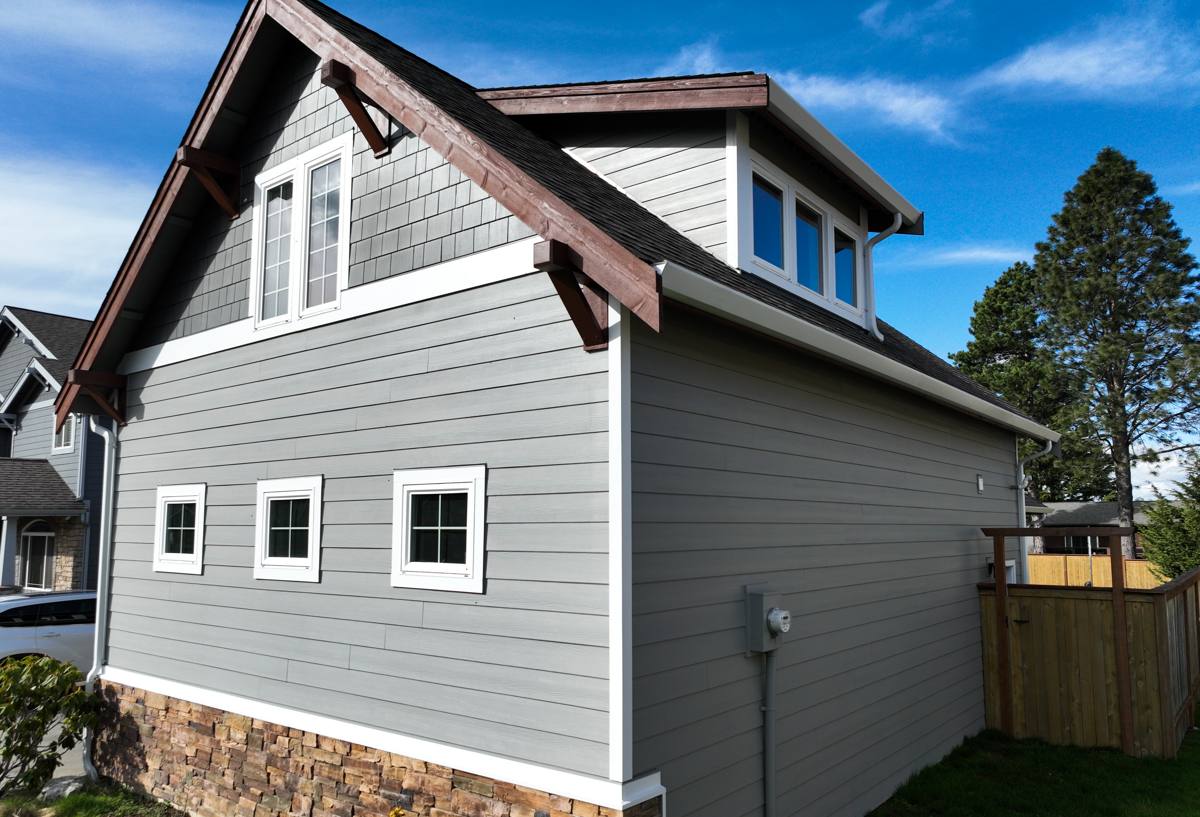
We made a decision as a company to install one siding system: James Hardie fiber cement. We don't install vinyl, LP SmartSide, Cemplank, Allura, primed spruce, or cedar. That's not a marketing position — it's a standard we hold because of what we've seen these materials do (and not do) in exactly this kind of climate over time.
- Non-combustible material — fiber cement doesn't burn, feed, or support flame spread the way wood-based and some engineered wood products can.
- Engineered for moisture — Hardie's HZ5 product line is specifically formulated for the Pacific Northwest's wet climate zone, addressing moisture and freeze-thaw behavior directly in the manufacturing process.
- Factory-applied ColorPlus finish — the finish is baked on at the factory under controlled conditions, rather than field-painted, which gives it more consistent adhesion and UV resistance than a job-site paint job.
- Doesn't feed moss and algae the way organic materials do — fiber cement is an inorganic material, so it doesn't provide the same food source and moisture retention that wood fiber products do, which matters directly in a climate like this one.
- Strong, transferable warranty backing — Hardie backs its products with warranty coverage that has real teeth, and that coverage can transfer to a new owner if the home sells.
We're not going to tell you every other product on the market is junk — vinyl, LP SmartSide, and engineered wood all have legitimate use cases and loyal installers. But once we saw the pattern of callbacks, moisture issues, and premature repainting on wood-based and lower-grade products in this specific climate, we stopped installing them. Fiber cement, installed correctly, is what we're willing to put our name on.
How We Approach a Siding Project in Nooksack
Assessment First
Before we talk about new siding, we look at what's actually happening on the home now — where moisture has gotten in, whether there's damage to sheathing or framing behind the existing siding, how the current flashing and weather barrier are performing, and where the sun and shade patterns create the moss-prone zones we mentioned above. A siding job that skips this step and just re-covers a problem is a job that fails again in a few years.
Installation to Spec
James Hardie siding performs the way it's rated to perform only when it's installed to manufacturer specification — correct fastener placement, proper clearances, correct flashing and water-resistive barrier detailing, and correct joint treatment. Most of the siding failures we get called out to inspect on other companies' installs aren't material failures — they're installation failures. That's the part that separates a siding job that lasts twenty-plus years from one that needs attention in five.
Weather-Aware Scheduling
Given how much of the year is wet in this region, we plan exterior work around realistic weather windows rather than pushing installation into conditions that compromise the work. A rushed install in the wrong weather is one of the more common ways corners get cut on exterior projects around here.
Roofing, Windows, and Decks — The Rest of the Building Envelope
Siding doesn't work in isolation. The roof, windows, and any deck or exterior structure all interact with the same moisture load, and a weak point in any one of them can undermine the others.
Roofing
Roofing in this climate deals with the same driving rain, moss, and prolonged dampness as siding, plus the added stress of standing water risk on lower-slope sections and valleys if drainage isn't correct. We inspect roof condition as part of any full exterior evaluation, because a roof that's letting moisture in above the wall line will eventually show up as a siding or sheathing problem below it.
Windows
Window flashing and sealant integration with the siding plane is one of the most common failure points we find on older homes. Even a well-installed window can leak if the siding around it wasn't integrated with the flashing correctly — this is one of the reasons we treat window replacement and siding work as connected, not separate, projects when both are on the table.
Decks
Decks in this climate face the same moss, algae, and prolonged dampness issues as siding, with the added factor of horizontal surfaces that hold standing water longer. Ledger board attachment and flashing where a deck meets the house is a common spot for hidden moisture damage, and it's worth an inspection any time deck or siding work is being planned.
Comparing Siding Options in a Wet Climate
| Factor | Fiber Cement (James Hardie) | Vinyl | Engineered Wood / Wood-Based |
|---|---|---|---|
| Moisture absorption | Does not absorb moisture into the material itself | Doesn't absorb, but seams and fasteners can allow water behind it | Wood fiber can absorb moisture over time if edges or coating are compromised |
| Combustibility | Non-combustible | Combustible | Combustible |
| Moss/algae susceptibility | Low — inorganic surface | Low, but seams trap grime | Higher — organic material can support growth if coating fails |
| Finish durability | Factory-baked ColorPlus finish | Color molded through, can fade/chalk over time | Typically field- or factory-painted, requires more frequent maintenance |
| Typical service life when installed to spec | Multiple decades | Multiple decades, but seams and warping are common issues | Shorter if moisture management fails |
This table reflects general material behavior, not a claim about any specific competitor's product performance — every installation's outcome depends heavily on the quality of the install itself.
Signs Your Siding Needs Attention
- Soft or spongy spots when you press on the siding, especially near the bottom edge or around windows
- Visible moss or algae buildup that keeps returning after cleaning
- Peeling, bubbling, or chalking paint on wood-based or engineered wood siding
- Warping, buckling, or gaps opening up at seams and joints
- Discoloration or staining that suggests water is tracking behind the siding rather than running off it
- Rising interior humidity, musty smell, or visible mold near exterior walls
What to Expect When You Reach Out
We start with a walk-around inspection of the home's exterior — siding, roofline, window integration, and any deck structures if those are part of the conversation. From there we give you an honest read on what's actually needed versus what can wait, along with a clear explanation of why we'd recommend James Hardie fiber cement for the work and what that would look like on your specific home. We're not going to push a full siding replacement if a targeted repair solves the actual problem.
If you're in Nooksack or anywhere else in our Whatcom County service area and you're seeing any of the warning signs above — or you just want a straight answer on the condition of your home's exterior — reach out for a free, no-pressure estimate using the form below.