 Birch Bay Siding
 Exterior Work in Cottonwood Beach
Cottonwood Beach sits right up against the water in the Birch Bay area of Whatcom County, and that location shapes everything about how a home's exterior ages here. Homes this close to the shoreline take on a different set of stresses than a house fifteen miles inland — salt-laden air, wind-driven rain that hits siding sideways instead of straight down, and a wet season that stretches long enough to give moss and algae months to establish themselves on anything that stays damp. We work on siding, roofing, windows, and decks throughout this stretch of Birch Bay, and Cottonwood Beach is one of the areas where we see exterior materials get tested the hardest.
This page walks through what that environment actually does to a home's exterior over time, how we approach siding replacement for homes in this specific setting, and why our crew installs one product — James Hardie fiber cement — rather than the broader mix of siding materials still common on older homes in the area.
What the Cottonwood Beach Climate Does to Siding
Salt Air
Proximity to salt water means airborne salt settles on exterior surfaces constantly, not just during storms. Salt is corrosive to exposed metal fasteners and trim, and it accelerates the breakdown of paint films and lower-grade siding materials. On wood-based products, salt exposure combined with moisture speeds up the cycle of swelling, cracking, and paint failure.
Driving Rain
Whatcom County's weather off the water rarely comes straight down. Wind-driven rain pushes moisture into seams, laps, and butt joints that a calmer rain would never reach. Any siding product with weak points at its joints — places where water can wick in and get trapped behind the surface — is more exposed here than it would be in a drier, less windy inland location.
The Long Moss Season
Marine climates like this one stay damp and shaded for much of the year, which is exactly what moss, algae, and mildew need to take hold. Once organic growth establishes itself on a siding surface, it holds moisture against the material, which compounds whatever damage the salt air and rain are already causing. Siding that can't shed water quickly or that has a porous, absorbent surface is far more prone to this kind of growth than a dense, factory-finished material.
Put those three factors together — salt, wind-driven moisture, and near-constant dampness — and it's clear why exterior materials that perform fine in drier parts of the state can struggle on a home two blocks from the water in Cottonwood Beach.
Why We Only Install James Hardie Siding
We get asked fairly often why we don't offer vinyl, LP SmartSide, cedar, or other fiber cement brands like Cemplank or Allura. It's a fair question, and the honest answer is that we made a deliberate decision as a company to standardize on one product line because it's the one we trust to hold up in this specific climate, installed correctly, for decades.
Vinyl Siding
Vinyl is affordable and low-maintenance in a general sense, but it's a thin plastic product that expands and contracts significantly with temperature swings, can crack in impacts, and tends to fade over time — especially darker colors, which lose their finish faster under UV exposure. In a coastal wind environment, vinyl panels are also more prone to rattling loose or blowing off in gusts if not installed with tight tolerances. It's a reasonable product for some situations; we just don't think it's the right long-term investment for a home exposed to Birch Bay conditions.
LP SmartSide and Engineered Wood
LP SmartSide is a wood-strand product with a resin-treated surface, and it performs reasonably well when detailing and maintenance stay on top of it. But it's still an engineered wood product at its core, meaning cut edges and any breach in the factory coating are vulnerable points for moisture intrusion. In a climate with this much sustained dampness, that's a maintenance burden we don't think homeowners should have to carry.
Cedar and Primed Spruce
Natural wood siding has real appeal — it looks great and has a long history in this region — but it demands ongoing refinishing, is a food source for rot and insects when moisture gets in, and is combustible. In a marine climate with a long wet season, the maintenance cycle on real wood siding is steep, and skipping a re-coat or two can shorten its life considerably.
Other Fiber Cement Brands
Products like Cemplank and Allura are also fiber cement, and fiber cement as a category is the right general direction for this climate. Where we draw the line is with James Hardie specifically — its ColorPlus factory-applied finish, its HZ5 product engineering for this region's weather, and the strength of its transferable warranty are what led us to standardize on it rather than split our crews' expertise and our warranty backing across multiple brands.
How James Hardie Performs in This Environment
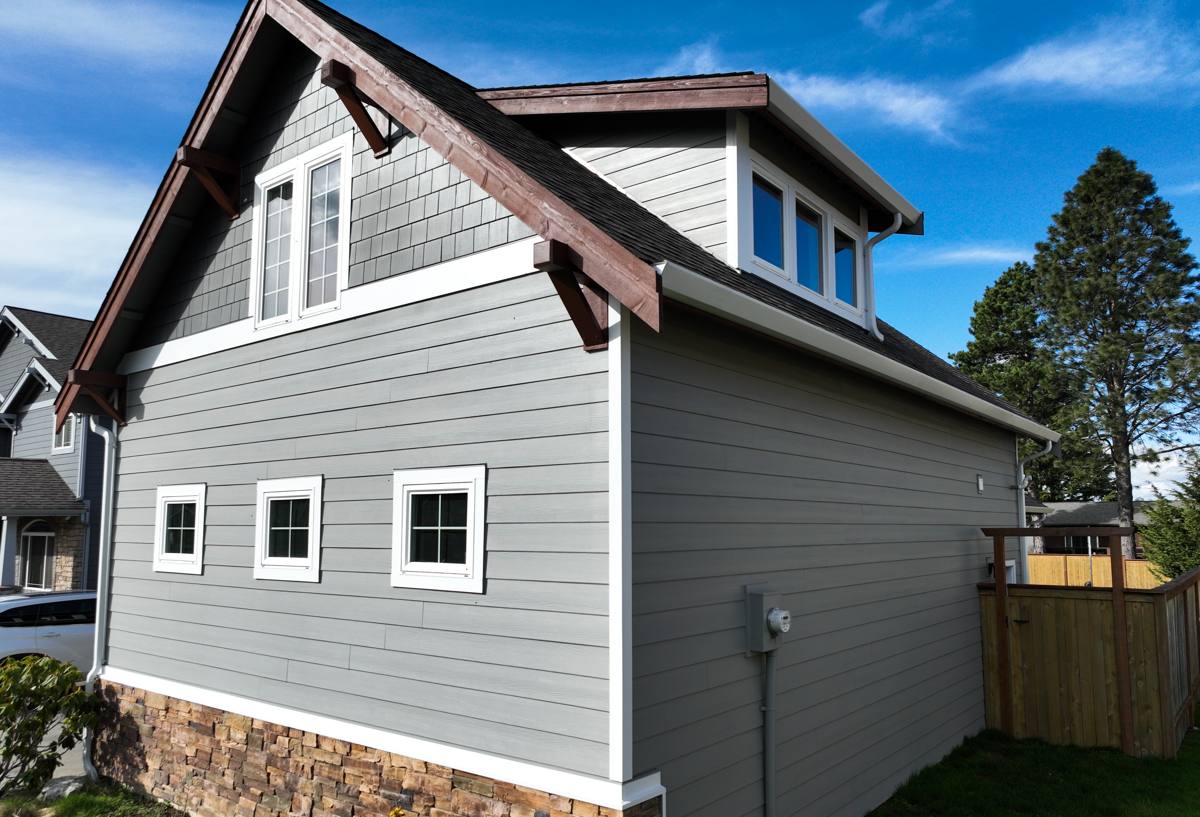
James Hardie siding is fiber cement — a mix of cement, sand, and cellulose fibers, engineered to be non-combustible and dimensionally stable. It doesn't expand and contract the way vinyl does, it doesn't rot the way untreated wood does, and it holds paint far longer than wood substrates because the ColorPlus finish is baked on at the factory under controlled conditions, not brushed or sprayed on-site.
For a location like Cottonwood Beach, the practical benefits are:
- A dense, non-porous surface that sheds wind-driven rain instead of absorbing it
- A factory finish engineered to resist fading and holds up against salt air exposure far better than field-applied paint
- Non-combustible material composition, which matters for insurance considerations and general fire safety
- HZ5 product lines specifically engineered for cold, wet, high-moisture climates like the Pacific Northwest
- A transferable limited warranty that adds real value if the home is ever sold
None of that means Hardie siding is maintenance-free — no exterior product is. But it means the material itself isn't the weak point in the system the way porous or moisture-sensitive materials can be.
Comparing the Options
| Material | Moisture Resistance | Maintenance | Fire Rating | Typical Lifespan (Installed Correctly) |
|---|---|---|---|---|
| Vinyl | Fair — can trap moisture behind panels if installed loosely | Low, but limited repair options | Combustible | 15-25 years |
| LP SmartSide | Fair — vulnerable at cut edges and breaches | Moderate — coating and caulking upkeep | Combustible | 20-30 years |
| Cedar / Primed Spruce | Poor without diligent upkeep | High — regular refinishing needed | Combustible | 15-25 years, highly maintenance-dependent |
| James Hardie Fiber Cement | Strong — dense, non-porous, engineered finish | Low — occasional wash, no refinishing needed for years | Non-combustible | 30-50 years |
Roofing, Windows, and Decks in the Same Climate
Siding doesn't work in isolation — the whole building envelope has to manage moisture together, which is why we handle roofing, windows, and decks alongside siding rather than treating them as separate projects.
Roofing
A roof system in this area needs to shed water efficiently and resist moss growth, since a moss-covered roof holds moisture against roofing material and shortens its life. Proper ventilation and flashing detail matter as much as the roofing material itself, especially where roof meets siding.
Windows
Window flashing and sealing are common failure points on coastal homes — wind-driven rain finds gaps around poorly flashed window openings faster than almost anywhere else on the exterior. When we replace siding, we also inspect window flashing, since a new siding job installed around a poorly sealed window just locks the problem in for another decade.
Decks
Decks in Cottonwood Beach face the same salt air and dampness as siding, plus direct sun and foot traffic. Materials and fastener choices matter here too — corrosion-resistant hardware isn't optional this close to the water.
What a Siding Project Looks Like
Every home is different, but a typical siding replacement follows a similar sequence:
- On-site inspection to assess current siding condition, moisture damage, and underlying sheathing
- Discussion of Hardie product line, plank style, and color options suited to the home
- Removal of old siding and inspection/repair of house wrap, flashing, and sheathing underneath
- Installation of new weather-resistive barrier where needed
- Installation of James Hardie siding to manufacturer specifications, including proper fastening, clearances, and joint treatment
- Final walkthrough and warranty documentation
That middle step — inspecting what's underneath the old siding — is often where the real problems show up. In coastal Whatcom County, it's common to find moisture damage to sheathing or framing that was hidden behind failing siding for years. Catching that during a siding project, rather than leaving it covered up, is part of doing the job right.
Signs a Cottonwood Beach Home May Need New Siding
- Visible moss or algae growth that returns quickly after cleaning
- Paint that's peeling, bubbling, or chalking faster than expected
- Soft or spongy spots when pressing on siding, especially near the bottom courses
- Warping, cracking, or separation at seams and corners
- Rising heating bills that may point to a compromised building envelope
- Visible gaps or caulking failures around trim and window edges
Why a Local Crew Matters Here
Installation quality determines how well any siding product performs, and that's especially true in a demanding coastal environment. Correct flashing details, proper fastener spacing, appropriate clearances at grade and roof lines, and attention to how water moves around the whole building envelope are all things that separate a siding job that lasts thirty-plus years from one that fails at the seams within a decade. A crew that regularly works homes in Birch Bay and the surrounding Whatcom County coastline understands these local conditions firsthand — not as a generic checklist, but as the specific weather pattern this stretch of shoreline deals with every year.
Cost Factors to Expect
| Factor | Why It Affects Cost |
|---|---|
| Home size and siding square footage | More surface area means more material and labor |
| Existing damage or rot | Sheathing or framing repair adds time and material beyond the siding itself |
| Siding profile and finish | Lap width, texture, and color selection affect material pricing |
| Trim and detail complexity | Homes with more corners, dormers, or architectural detail take more labor |
| Accessibility | Multi-story sections or tight lot access can affect labor time |
We don't quote pricing without seeing the home — too many of these factors vary house to house for a generic number to mean much. What we can say is that we price the job as it actually is, not as an estimate that changes once work starts.
Get a Free Estimate
If you're in Cottonwood Beach or elsewhere around Birch Bay and want an honest read on your home's siding, roofing, windows, or deck, we're happy to take a look. There's no pressure and no cost to get a straightforward assessment and, if it makes sense, a quote for James Hardie siding built for this exact climate. Fill out the form below to get started.