 Birch Bay Siding
 Why Birch Bay Village Windows Take More Punishment Than Most
Birch Bay Village sits close enough to the water that the air itself works against your windows. Salt-laden marine air corrodes hardware, pits aluminum, and breaks down cheap seals faster than the same products would fail further inland. Add in the driving rain that comes off the water sideways during winter storms, and you've got wind-driven moisture testing every seam around every window, every season. Whatcom County's long, damp moss season doesn't help either — the same humidity that keeps roofs and siding green year-round also keeps window frames, sills, and trim wet for extended stretches, which is exactly the condition that rots wood, swells vinyl, and feeds mold growth on interior sills.
None of this means windows fail overnight. It means the wrong product, or a correctly-rated product installed poorly, shows its weaknesses in this specific climate years before it would somewhere drier. A window that's fine in eastern Washington can underperform badly a few blocks from Birch Bay Village's shoreline.
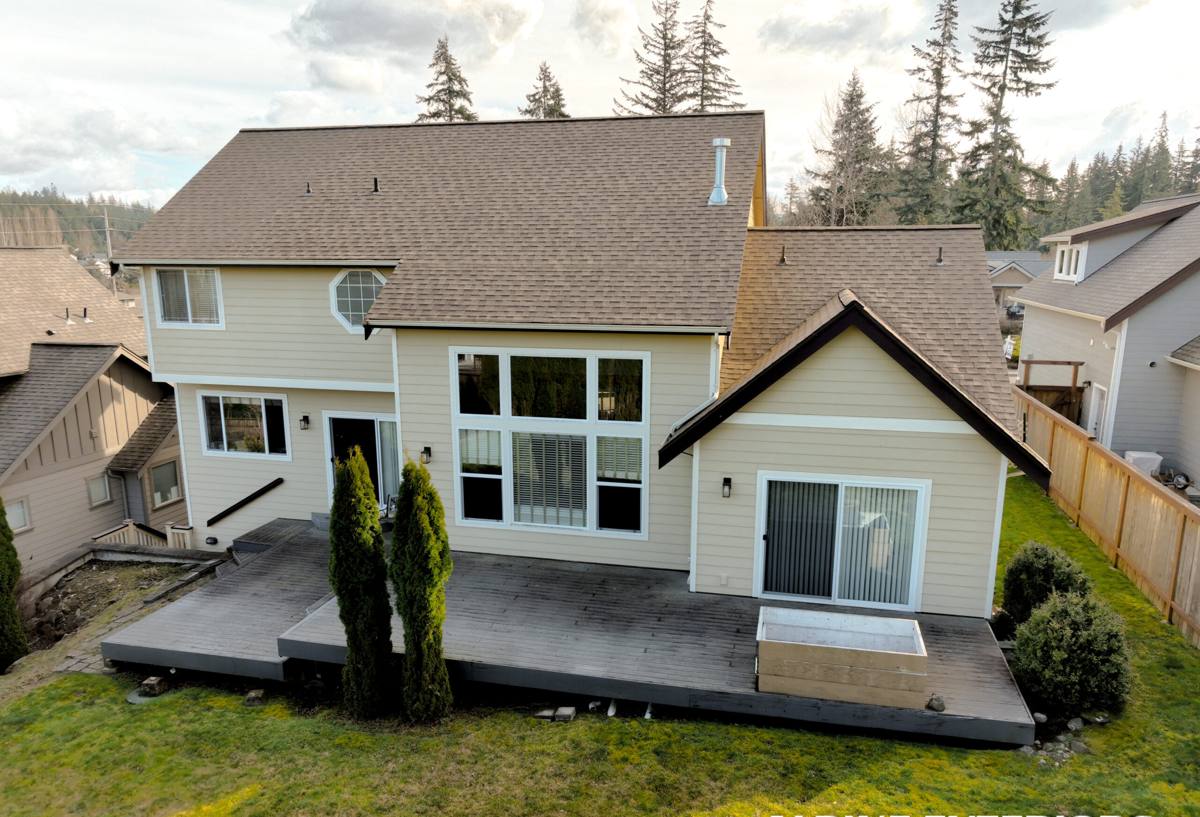
What "Energy-Efficient" Should Actually Mean Here
Energy-efficient window marketing throws around a lot of numbers. In a coastal Whatcom County home, only a few of them actually matter:
- U-factor — how much heat escapes through the window. Lower is better for our cool, wet winters where heating runs for months at a time.
- Solar Heat Gain Coefficient (SHGC) — how much solar heat passes through the glass. Less critical here than in sunnier climates, but still worth balancing against west-facing exposure toward the water.
- Air infiltration rating — how much air leaks around the sash even when it's closed. This is the number that matters most against wind-driven rain and gusty marine weather.
- Condensation resistance — how well the glass and frame resist interior fogging in a humid, temperature-swinging environment.
Double-pane windows with low-E coatings and argon gas fill cover most homes here adequately. Triple-pane adds real value mainly on exposed, wind-battered elevations facing open water, or for homeowners prioritizing quiet and consistent interior temperatures over the added cost. It's rarely worth paying for on every opening in a home — we'll tell you honestly where it pays off and where it doesn't.
Frame Material: The Decision That Matters Most in Salt Air
Glass package gets most of the attention, but frame material is what determines how the window ages in a marine environment. Here's the honest comparison:
| Frame Material | Salt Air / Moisture Performance | Maintenance | Typical Cost Position |
|---|---|---|---|
| Vinyl | Won't corrode; can become brittle at very old age | Low — occasional cleaning | Most affordable |
| Fiberglass | Excellent — dimensionally stable, resists moisture and salt exposure | Low | Mid to upper |
| Wood-clad | Good if cladding stays intact; exposed wood is vulnerable to rot | Higher — cladding seams need periodic inspection | Upper |
| Bare aluminum | Poor — pits and corrodes faster in salt air; conducts cold, inviting condensation | Moderate to high | Lower to mid |
We steer most Birch Bay Village homeowners toward vinyl or fiberglass, not because other materials are bad products, but because they hold up with the least maintenance in this specific air and rain exposure. Bare aluminum frames, in particular, are something we generally avoid recommending on homes this close to the water — not because the product is defective, but because the maintenance burden and long-term corrosion risk don't make sense given the alternatives available at similar price points.
What a Correct Installation Actually Involves
The window itself is only part of the job. Most premature window failures we see aren't the glass or the frame — they're the installation. In a driving-rain climate, the flashing and sealing details determine whether water gets managed or gets trapped behind the siding.
The details that matter
- Proper flashing integration with the existing weather-resistive barrier, so water is directed out and down, never behind the sheathing
- Sill pan flashing under every unit, creating a backup drainage path if any water does get past the primary seal
- Correct shimming and squaring so the sash operates smoothly and seals evenly for the life of the window
- Sealants and flashing tapes chosen to be compatible with your siding material, not just whatever's on the truck
- Interior air sealing around the frame, which matters as much for energy performance as the glass package itself
This is where hiring a siding contractor for window work has a real advantage over a windows-only outfit: the flashing has to tie into the siding and weather barrier correctly, and that's the exact envelope work we do every day. A window crew that doesn't also handle siding sometimes treats the window as an isolated box; we treat it as one piece of a continuous water-management system around your home.
Signs Your Current Windows Are Already Costing You
Not every window that looks fine is performing fine. Before recommending replacement, we look for these signs — and you can check for most of them yourself:
- Condensation or fogging between the panes of a double-pane unit (seal failure — not fixable, glass needs replacing)
- Persistent condensation on the inside of the glass, especially during moss season, pointing to poor air sealing or an outdated glass package
- Windows that stick, won't latch, or are hard to open — often swelling from moisture intrusion around the frame
- Visible corrosion on aluminum hardware or frames, or soft/discolored wood at the sill
- A noticeable draft when standing near a closed window during a windstorm off the water
- Rooms that are consistently harder to heat or cool than the rest of the house
Any one of these is worth a look. Several of them together usually mean the windows are actively working against your energy bills, not just showing cosmetic age.
What Drives the Cost of a Window Replacement Project
Every home is different, but the cost of a project breaks down along a handful of predictable factors:
| Factor | Why It Moves the Price |
|---|---|
| Number and size of openings | More glass and larger units mean more material and labor per project |
| Frame material chosen | Vinyl, fiberglass, and wood-clad sit at different price points, as shown above |
| Glass package | Double-pane low-E vs. triple-pane vs. specialty coatings for sun or sound |
| Installation type | Replacing within the existing frame ("pocket" replacement) is faster than a full-frame replacement that exposes and redoes the flashing |
| Condition behind the old window | Rot or water damage found once the old unit is out adds repair scope — this is common enough near the water that we build the possibility into the estimate conversation upfront |
| Access and second-story work | Staging and safety equipment for upper floors adds labor time |
We'll always tell you plainly which of these apply to your project and why, rather than handing you a number with no explanation behind it.
Our Process for Birch Bay Village Projects
- On-site assessment — we look at every opening, note frame material, orientation, and any visible water or rot damage before recommending anything
- Honest product recommendation — matched to that specific opening's exposure, not a one-size answer for the whole house
- Measurement and ordering — precise measurements matter more here than in a dry climate, since a poor fit is where water finds its way in
- Removal and flashing — old units come out carefully so we can inspect and correct the flashing and weather barrier underneath before the new window goes in
- Installation and sealing — squared, shimmed, flashed, and sealed to manage water first and insulate second
- Final walkthrough — every opening tested for smooth operation and a tight seal before we consider the job done
Why a Crew That Already Works This Neighborhood Matters
Birch Bay Village homes face a narrower, more specific set of conditions than the general "Whatcom County" climate — proximity to the water, direct exposure to wind-driven rain, and the salt air that comes with both. A crew that works this specific area regularly knows which elevations of a home typically take the worst weather, which frame materials hold up and which don't, and how to sequence window work around the siding and trim without leaving gaps for water to find. That familiarity shows up as fewer surprises during the job and fewer callbacks after it. If your community has its own exterior guidelines, we're used to working within those as well, so the finished look stays consistent with the rest of the neighborhood.
If you're weighing window replacement for a Birch Bay Village home, we're happy to take a look and give you a straight answer — including telling you if repair or partial replacement makes more sense than doing every opening at once. Reach out for a free, no-pressure estimate using the form below.