 Birch Bay Siding
 Exterior Work in Marietta, Birch Bay
Marietta sits close enough to the water that its homes deal with a different set of exterior problems than houses ten or fifteen miles inland in Whatcom County. Salt-laden air moves off Birch Bay and Semiahmoo Bay year-round, driving rain comes in sideways during fall and winter storms, and the long, damp Pacific Northwest shoulder seasons keep exterior surfaces wet for weeks at a stretch. None of that is dramatic on any given day. It's the accumulation — months and years of it — that separates a siding, roofing, window, or deck job that holds up from one that quietly fails from the outside in.
We work this area regularly, which matters more than it might sound like. A crew that only sees Marietta a few times a year doesn't build the same instinct for where water actually goes on a home this close to the bay, or how fast moss and algae take hold on a north-facing wall that never fully dries. That instinct shapes real decisions on a job site: where to add extra flashing, how much of a gap to leave for drainage, which details to slow down on even when the schedule says to move faster.
What Marietta's Climate Does to a House
Three conditions do most of the damage to exterior building materials in this part of Whatcom County, and they don't act alone — they compound each other.
Salt Air
Proximity to Birch Bay means airborne salt settles on siding, trim, fasteners, and roofing hardware. Salt is corrosive to unprotected metal and it's hygroscopic — it pulls moisture out of the air and holds it against whatever surface it lands on. Over years, that combination accelerates rust on fasteners and flashing, and it degrades paint films and coatings that weren't formulated to handle it.
Driving Rain
Storms off the Salish Sea don't just fall straight down here — wind pushes rain sideways into wall assemblies, under trim, and behind loosely installed siding. A house can shed a normal vertical rain without issue and still take on water during a wind-driven event if the water-resistive barrier, flashing, and siding laps weren't detailed correctly.
Moss and Algae Season
Whatcom County's wet season runs long — realistically September through May in most years — and shaded, north- and east-facing exteriors rarely get a full dry-out between rain events. That's exactly the environment moss, algae, and mildew need. On roofing it degrades shingles and clogs valleys and gutters. On siding it holds moisture against the surface and, on materials that aren't dimensionally stable, contributes to swelling, cupping, and paint failure.
| Condition | Primary Risk | Most Affected Materials |
|---|---|---|
| Salt air | Corroded fasteners, coating breakdown | Unprotected metal, standard paints |
| Driving rain | Water intrusion behind cladding | Poorly flashed siding, gapped trim |
| Extended damp season | Moss, algae, wood rot | Wood-based siding, shaded roof sections |
Why We Only Install James Hardie Fiber Cement Siding
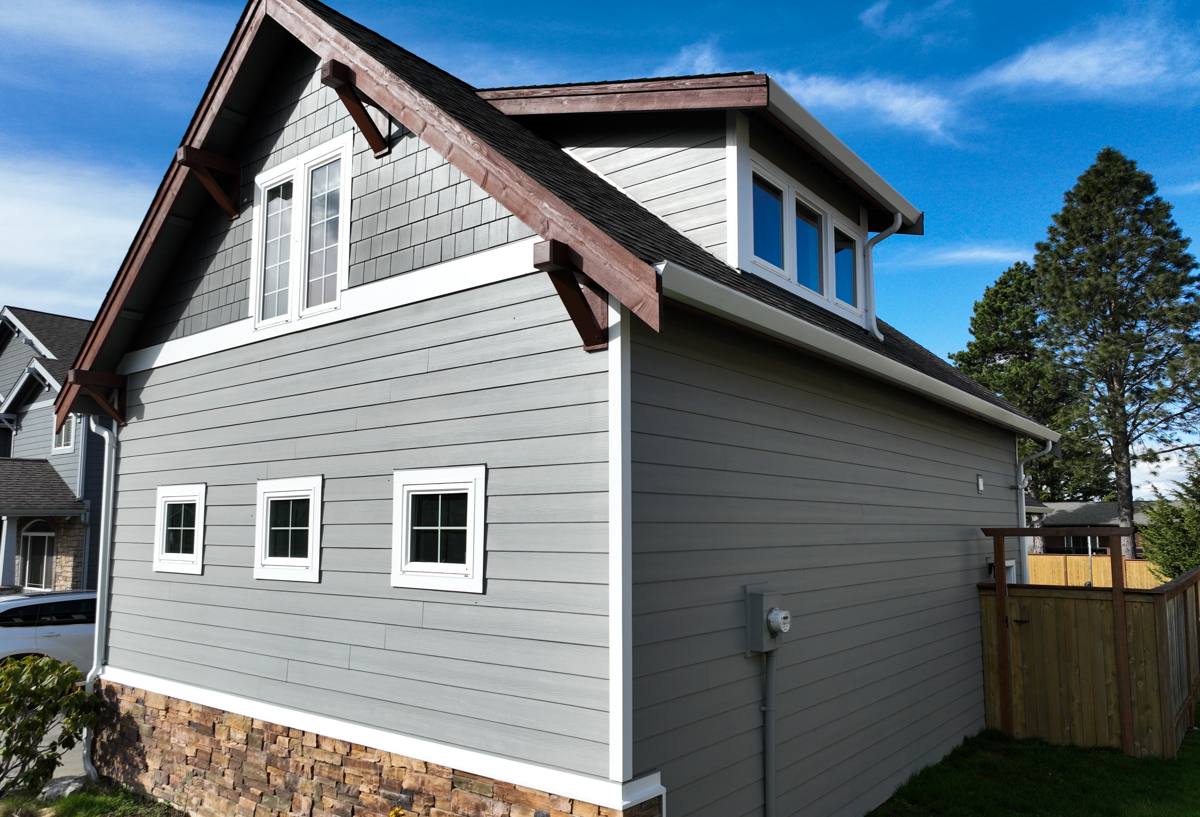
We made a deliberate decision to standardize on James Hardie fiber cement siding for every siding job we do, including here in Marietta. That's not a marketing position — it's a response to what we've seen this exact climate do to other materials over time.
Vinyl siding is affordable and low-maintenance in mild conditions, but it's a thin plastic product that can warp, fade, or crack in temperature swings and impacts, and its seams and panel laps give wind-driven rain more opportunities to find a way behind the cladding. LP SmartSide and other engineered wood products perform reasonably well when installation and maintenance are perfect, but they're wood-based — meaning moisture that gets past the surface can lead to swelling and, eventually, rot at edges, seams, and cut ends. Primed spruce and raw cedar are attractive traditional choices, but both require an ongoing paint or stain maintenance cycle to stay protected, and that cycle gets harder to keep up with in a climate that stays wet as long as this one does.
James Hardie fiber cement is cement, sand, and cellulose fiber — it doesn't absorb and swell the way wood-based products can, it's non-combustible, and it holds paint and factory finishes far longer than wood substrates because it's dimensionally stable. James Hardie's ColorPlus factory-applied finish is baked on under controlled conditions and backed by its own finish warranty, which matters in an area where DIY touch-up painting on a house exposed to salt air and long wet seasons is a losing battle. James Hardie also engineers HZ5 and HZ10 product lines specifically for climate zones like the Pacific Northwest, accounting for moisture exposure in the product's design rather than leaving it entirely up to caulking and paint.
We're upfront that this means we turn down some jobs where a homeowner wants vinyl or engineered wood installed. We'd rather be honest about why than install something we don't think will hold up here.
Roofing, Windows, and Decks — the Rest of the Exterior
Siding is only part of what protects a Marietta home. We handle the full exterior envelope because these systems interact — a roofing problem shows up as a siding stain, a failed window flashing shows up as rot in the wall behind the trim, and a deck built without the right ledger flashing sends water straight into the house.
Roofing
Roof valleys, flashing at penetrations, and gutter systems all need to move water off the house fast and keep it away from the walls below. In a moss-prone area like Marietta, roof material choice and regular clearing matter as much as the initial installation.
Windows
Window flashing and integration with the siding's water-resistive barrier is one of the most common failure points we find on homes we open up for re-siding. A window that isn't flashed correctly will leak eventually, regardless of how good the window itself is.
Decks
Ledger board flashing, joist protection, and material choice for a deck exposed to salt air and standing moisture all affect how long a deck lasts before structural repairs are needed, not just how it looks in year one.
How We Approach a Marietta Job
The process is similar across siding, roofing, window, and deck work, and it's built around not skipping the parts that don't show up in a finished photo.
- Assessment: We look at the whole exterior, not just the material the homeowner called about — a siding call often surfaces a roofing or window flashing issue worth addressing at the same time.
- Moisture and structural check: Before any new material goes on, we check what's underneath. Covering up existing rot or trapped moisture just hides the problem.
- Water management detailing: Flashing, house wrap integration, and drainage gaps are planned before installation starts, not improvised as we go.
- Installation to manufacturer spec: For James Hardie siding specifically, that means correct fastener type and spacing, proper clearances, and factory-recommended caulking and finishing — details that directly affect whether the warranty is valid.
- Walkthrough and cleanup: We go over the finished work with the homeowner and leave the site clean.
Why a Local Crew Matters Here
Marietta isn't a large area, and the homes here share enough in common — age, exposure, orientation to the water — that a crew who works this specific stretch of Whatcom County builds real, specific knowledge over time. That shows up in small decisions: recognizing a roofline that traps moisture, knowing which sides of a house in this neighborhood take the worst of the winter wind, and understanding that a coating or caulk that works fine in a drier inland town won't necessarily hold up a few miles from Birch Bay. A crew that treats every job as a one-off in an unfamiliar location tends to default to generic solutions. We'd rather bring what we've already learned about this area to your house.
What Affects Cost on a Marietta Exterior Project
Every home and every job is different, so we don't publish fixed pricing — but these are the factors that most commonly move a project's cost up or down.
| Factor | Why It Matters |
|---|---|
| Existing damage or rot | Hidden moisture damage found during tear-off adds repair scope before new material goes on |
| Home size and complexity | More corners, gables, and trim detail means more labor and material |
| Material and color selection | James Hardie panel and lap styles, plus ColorPlus color choice, affect material cost |
| Accessibility | Multi-story sections, steep grades, or tight lot access affect equipment and labor time |
| Scope bundling | Combining siding with roofing, window, or deck work in one project can reduce overall disruption and setup costs |
Maintenance Checklist for Marietta Homes
Even with materials chosen for this climate, a little regular attention extends the life of your exterior significantly.
- Clear moss and debris from roof valleys and gutters at least twice a year, more often under overhanging trees
- Rinse siding periodically to remove salt residue and organic growth before it builds up
- Inspect caulking around windows, doors, and trim joints annually and reseal where it's cracked or pulled away
- Check deck ledger boards and fasteners yearly for corrosion or loosening
- Trim back vegetation that keeps a wall or roof section shaded and slow to dry
- Walk the exterior after major storms to spot dislodged flashing or damaged panels early
Get an Estimate for Your Marietta Home
If you're dealing with aging siding, a roof that's taken on moss and wear, windows that leak in a storm, or a deck that needs attention, we're happy to take a look and give you an honest read on what's going on and what it would take to fix it right. Reach out for a free, no-pressure estimate — there's no obligation, and we'll tell you plainly what we see, whether that's a small repair or a full replacement.