 Birch Bay Siding
 Why Bellingham Decks Take a Beating
A deck in Bellingham lives a harder life than most homeowners realize. Between the salt-tinged air drifting in off the water, months of steady driving rain, and a moss season that can stretch from fall through spring, the wood, fasteners, and framing underneath your deck boards are under constant low-grade attack. None of it looks dramatic day to day. It just adds up — a little more moisture trapped here, a little more corrosion there — until a board that looked fine last summer is spongy underfoot, or a railing post that used to feel solid starts to wiggle.
We work on decks throughout Whatcom County, and the pattern is consistent: the damage is almost never random. It shows up in the same spots, for the same reasons, on house after house. Understanding those patterns is what separates a repair that actually holds up from one that just covers the problem with new boards.
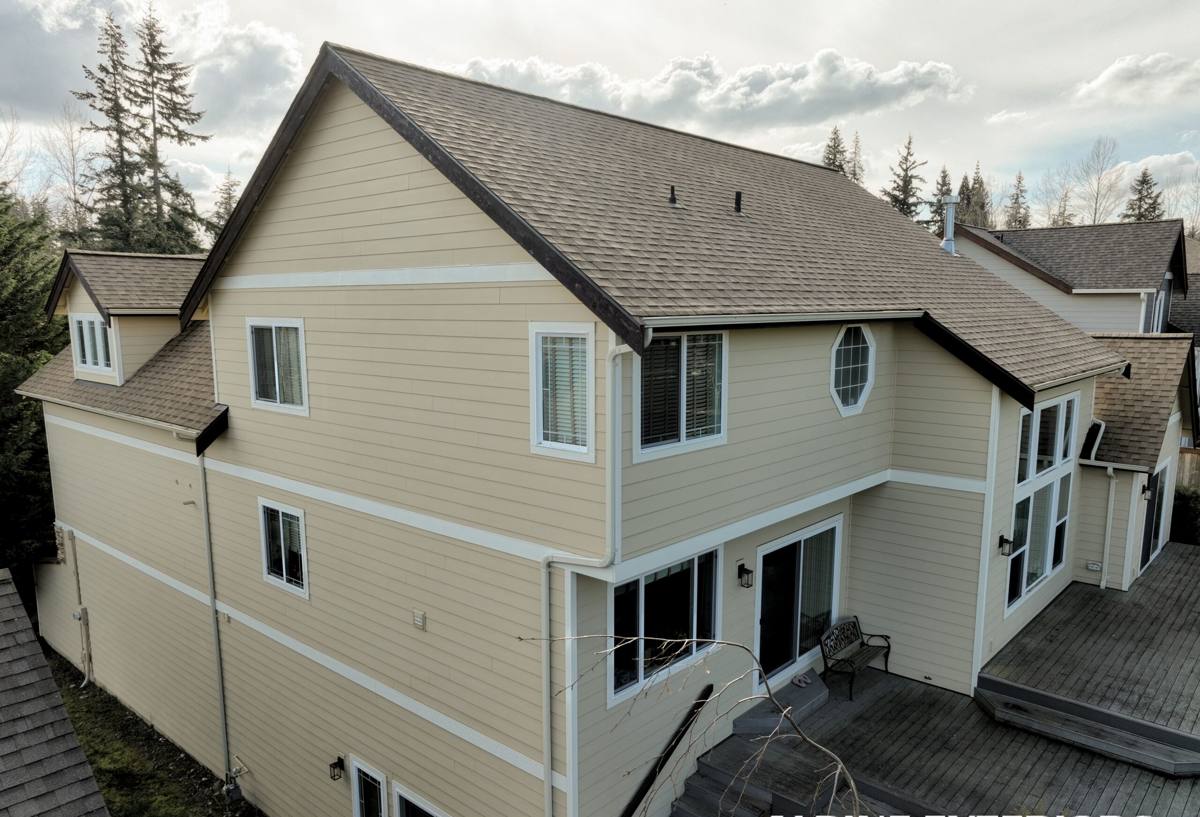
Common Deck Problems We See in Bellingham Homes
Moisture Trapped Where It Can't Escape
The biggest culprit is almost always moisture that has nowhere to go. Deck boards installed tight together, debris packed into the gaps, or a ledger board sealed against the house without proper flashing all trap water against wood that was never designed to stay wet. In a climate with as much rainfall as ours, that's a slow-motion problem that eventually shows up as soft, dark, or crumbling wood.
Moss, Algae, and Slick Surfaces
Moss doesn't just make a deck ugly and slippery — it holds moisture directly against the wood surface and accelerates decay underneath it. A deck that gets shaded part of the day, sits under trees, or simply doesn't dry out between rain events will grow moss faster than one that gets full sun. Left alone through a full moss season, that green film can hide real deterioration in the boards below it.
Corroded or Failing Fasteners
Nails, screws, and joist hangers that aren't rated for coastal-adjacent exposure corrode over time, and once a fastener starts to fail, the board or bracket it's holding loses its grip long before the wood itself looks bad. We routinely find decks where the visible boards are in decent shape but the hardware holding the structure together has rusted to the point of being unreliable.
Structural Weak Points: Ledger Boards, Posts, and Stairs
The ledger board (where the deck attaches to the house), the posts supporting the frame, and stair stringers take the most structural stress and the most water exposure. These are also the areas most likely to be improperly flashed or under-supported on older decks, and they're where a failure actually matters — not just cosmetically, but for safety.
Repair or Replace? How to Tell the Difference
Not every deck problem calls for a full rebuild, and not every squeaky board is a minor fix. The honest answer depends on what's happening underneath the surface, not just what you can see standing on top of it.
| Factor | Usually a Repair | Usually a Replacement |
|---|---|---|
| Deck boards | A handful of boards soft, cracked, or splintering | Widespread rot across most of the deck surface |
| Framing/joists | Isolated soft spots near a leak source | Rot or sagging across multiple joists |
| Ledger board | Flashing failure caught early, wood still sound | Ledger board itself is rotted or pulling from the house |
| Posts and footings | Posts sound, hardware needs upgrading | Posts rotted at grade or footings undersized/shifting |
| Railings/stairs | Loose balusters, wobbly handrail | Posts not properly anchored, stringers compromised |
| Age of structure | Newer deck with a specific, isolated problem | Older deck built without current flashing or connector standards |
The table above reflects general patterns, not a diagnosis — every deck needs to be looked at in person. A deck that seems like a "replace it" situation from the driveway sometimes turns out to have a perfectly solid frame under a few bad boards, and vice versa. That's why we don't quote repairs sight unseen.
What a Proper Deck Repair Actually Involves
Start Below the Surface
A repair that only addresses what's visible from above is a repair that will need to happen again. Before we replace a single board, we get underneath the deck (or pull boards as needed) to check the joists, ledger connection, posts, and hardware. If the framing has a moisture problem, replacing the decking on top of it just resets the clock on the same failure.
Match or Upgrade the Hardware
Any fasteners, joist hangers, or post connectors we replace get upgraded to hardware rated for our climate, not just whatever matches what was there before. This is one of the cheapest parts of a repair and one of the most important for how long it lasts.
Fix the Water Path, Not Just the Symptom
If a repair is being driven by trapped moisture, we address why the water was getting trapped in the first place — proper board spacing, correct ledger flashing, drainage that actually directs water away from the structure. Otherwise, new wood in the same conditions just starts the same clock over again.
Finish the Job Correctly
New boards, railings, or stair components get sealed, stained, or finished to match the existing deck as closely as possible, and fastened in a way that won't work loose or corrode prematurely. A repair should look intentional, not patched.
Our Deck Repair Process in Bellingham
- Inspection: We walk the full deck, check underneath it, test boards, railings, and stairs by hand, and identify every area of concern — not just the one you called about.
- Honest assessment: We tell you what's actually wrong, what's driving it, and whether a repair will hold up or whether you're better served by addressing a larger section.
- Written estimate: A clear scope of work and price before anything is touched — no surprise add-ons mid-project.
- Repair work: Framing, hardware, and structural issues are corrected first; decking, railings, and finish work come after the structure underneath is sound.
- Final check: We walk the deck with you when it's done so you know exactly what was repaired and why.
Decking Material Considerations for This Climate
When boards need to be replaced, what you replace them with matters as much as the workmanship. In a climate with this much rain and moss pressure, some materials simply hold up with less maintenance than others.
- Pressure-treated wood: Affordable and widely used, but it needs regular sealing and inspection to keep moisture from re-entering over time.
- Cedar: Naturally more decay-resistant and a common regional choice, though it still needs periodic maintenance to look and perform its best.
- Composite decking: Higher upfront cost but far less maintenance burden — no staining, better moisture resistance, though installation details (spacing, ventilation, fastening) matter more, not less, with composite products.
We'll walk you through the honest trade-offs for your specific deck and budget rather than pushing one product across the board. The right call often depends on how much shade the deck gets, how it's oriented, and how much ongoing maintenance you actually want to do.
Keeping Your Repaired Deck Ahead of Moss and Moisture
A good repair buys you years, but a little seasonal upkeep buys you more. This is especially true here, where moss season isn't a one-time event — it's an annual cycle your deck has to survive.
- Sweep debris out of board gaps regularly, especially in fall when leaves and needles accumulate
- Rinse or gently scrub moss and algae off the surface before it gets a foothold, rather than after
- Check that boards near the house and around planters aren't staying damp longer than the rest of the deck
- Inspect railings and stair connections by hand once or twice a year — loose hardware is easy to catch early and harder to catch late
- Reseal or restain wood decking on the schedule the product calls for, not just when it starts to look gray
- Keep gutters and downspouts near the deck clear so runoff isn't draining directly onto or under it
Why Hiring a Crew That Already Works in Bellingham Matters
Deck repair isn't a one-size-fits-all trade. A crew that mostly works drier inland climates will make different assumptions about flashing, fastener selection, and how much ventilation a deck needs than a crew that works Whatcom County year-round. We see the same handful of failure patterns repeatedly in this area because our conditions produce them repeatedly — and that familiarity is what lets us diagnose a problem quickly and fix it in a way that's built for what this climate actually does to a deck, not for a textbook average.
It also matters for the boring, practical stuff: knowing which products perform reliably here, understanding local permitting for structural work when it's needed, and being available for a follow-up check without a long drive. That's the value of hiring local, and it's why we focus on doing the work right the first time rather than making repeat trips.
Get an Honest Look at Your Deck
If your deck has soft spots, a wobbly railing, visible moss buildup, or you just haven't had it checked in a while, it's worth getting a second set of eyes on it before another wet season sets in. We offer free, no-pressure estimates for deck repair throughout the Bellingham area — use the form below to get started, and we'll give you a straight answer about what your deck actually needs.