 Birch Bay Siding
 Deck Replacement in Sumas: Built for a Whatcom County Valley Climate
Sumas sits inland, away from the open water that shapes conditions in the coastal parts of Whatcom County, but that doesn't mean a deck here gets an easy ride. The Nooksack River valley holds humidity and fog longer than higher, more exposed ground, and driving rain still finds its way sideways into wall and deck framing during fall and winter storms. Add in a moss season that runs most of the year on shaded surfaces, and a deck in Sumas faces a slower, damper version of the same wear that hits the rest of the county — one that shows up as soft boards, corroded fasteners, and a spongy substructure well before a homeowner expects it.
A deck takes that punishment differently than a wall does. Siding is mostly vertical, so gravity helps water run off. A deck surface is horizontal, which means rain, dew, and fog settle onto it and sit there until it dries — and in a valley setting like Sumas, that drying window is shorter than homeowners in drier parts of the state assume. That difference is the starting point for almost every decision on a correct deck replacement here, from how the framing is built to what decking material actually makes sense.
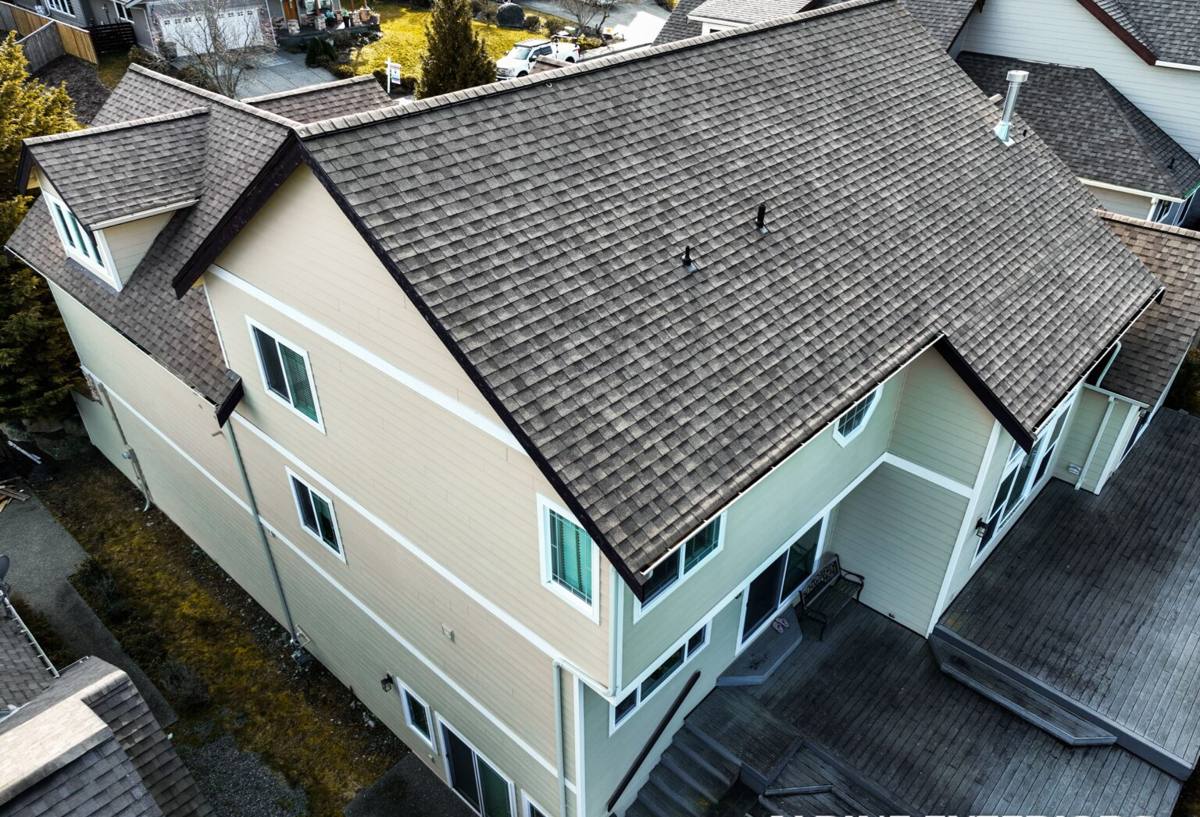
Why Sumas Decks Wear Out Faster Than the Manufacturer Numbers Suggest
Standing Water and Slow Drying
Product warranties and installation guides are usually written around an average national climate, not a low-lying valley that holds fog and moisture longer than the surrounding hills. A deck board rated for a certain service life assumes it gets to dry out between rain events. In Sumas, that assumption doesn't always hold, especially on decks under tree cover or on the shaded side of a house, where surfaces can stay damp for days after a storm passes.
Moss and Slip Risk on Horizontal Surfaces
Moss doesn't just discolor a deck — on a walking surface, it turns into a real slip hazard, and it grows fastest exactly where water sits longest. Gaps between boards, ledger connections, and stair treads are common starting points, and once moss and algae get established on a porous surface, pressure washing knocks it back temporarily without solving the underlying moisture problem.
Fastener and Hardware Corrosion
Sustained valley humidity is hard on metal. Fasteners, joist hangers, and structural connectors that aren't rated for the moisture exposure here corrode faster than the same hardware would in a drier climate, and a corroding fastener at a load-bearing connection is a structural problem, not a cosmetic one.
Wind and Winter Cold Snaps
Sumas sits near the corridor that funnels cold air down from the Fraser Valley in British Columbia, and it can see stronger, colder wind during winter cold snaps than towns farther south in the county. That combination of cold, wind, and moisture stresses framing connections and any gaps in flashing at the point where a deck attaches to the house — which is usually the single most important detail on the whole structure.
Repair or Replace? Reading the Signs on an Older Deck
Not every aging deck needs a full replacement. A deck with sound framing and a healthy ledger connection can sometimes be brought back with new decking boards, hardware upgrades, and a proper cleaning and refinishing. But once the framing itself, the ledger board, or the connection to the house is compromised, patching the surface just delays a bigger problem. These are the signs worth taking seriously:
- Soft, spongy, or visibly discolored boards, especially near the ledger or in shaded areas
- Rust staining bleeding out around fasteners or joist hangers
- Any give or bounce underfoot that wasn't there before
- Gaps, cracking, or staining where the deck attaches to the house — a common sign the ledger flashing has failed
- Loose, wobbly, or separating railings and posts
- Moss or dark staining that returns quickly after cleaning
If more than one of these shows up at once, or if the problem is concentrated at the ledger connection, it's usually a sign the framing has been absorbing moisture for a while — and that's the point where a full replacement, rather than a repair, becomes the honest recommendation.
What a Correct Deck Replacement Involves
Ledger Board and Structural Connection to the House
This is the single most important detail on any attached deck, and it's where a rushed job fails first. The ledger board carries a significant share of the deck's structural load, and it has to be flashed correctly where it meets the house so that water is directed away from the wall assembly rather than trapped behind the ledger. On older Sumas homes, this is frequently where we find hidden rot during a replacement — moisture that's been working behind an inadequately flashed ledger for years without showing an obvious sign on the surface.
Framing and Joist Layout
Framing lumber, joist spacing, and beam sizing all need to match the decking material and the deck's actual use, not just meet a minimum. Composite and PVC decking often call for tighter joist spacing than traditional wood decking, and a framing plan built around one material doesn't automatically work for another. We also build in proper clearance between the framing and the ground or the house siding, since trapped moisture at that gap is a common source of long-term rot.
Fasteners and Hardware
Given the valley humidity here, we use corrosion-resistant fasteners and structural hardware rated for sustained moisture exposure, not the cheapest option that meets a bare minimum spec. On the visible decking surface, hidden fastener systems are also worth considering — fewer exposed screw heads means fewer places for water to collect and start a rust stain.
Railings and Code Compliance
Railing height, baluster spacing, and post attachment all follow current Washington building code, and those requirements exist because railing failures are one of the more serious ways a deck can hurt someone. We build railings to meet code as a baseline, not as an afterthought bolted on at the end of the job.
Drainage and the Space Underneath
What happens under the deck matters almost as much as what happens on top of it. Grading that directs water away from the foundation, adequate ventilation under low decks, and gaps between boards that let water pass through instead of pooling all affect how long the structure lasts in a climate that doesn't give surfaces much time to dry out between storms.
Decking Material Options for a Valley Climate
| Material | Moisture & Moss Resistance | Maintenance | Typical Lifespan |
|---|---|---|---|
| Pressure-treated wood | Moderate — treatment resists rot but the surface stays porous | Regular cleaning, sealing, and periodic refinishing | Shorter, especially without consistent upkeep in this climate |
| Cedar | Naturally moderate rot resistance, but softer and more moisture-sensitive over time | Regular sealing and cleaning to maintain appearance and resistance | Moderate, dependent heavily on maintenance |
| Capped composite | Strong — a protective cap resists moisture absorption and moss adhesion better than wood | Occasional cleaning; no sealing or staining required | Longer, with less maintenance burden over the life of the deck |
| PVC decking | Very strong — fully synthetic, minimal moisture absorption | Minimal; typically just periodic cleaning | Long, though appearance and feel differ from wood-look composites |
There isn't a single right answer for every homeowner. Wood costs less upfront and has a traditional look many people prefer, but it asks for consistent maintenance in a climate that doesn't make that easy — skip a year of sealing and moss or soft spots can get ahead of you. Composite and PVC cost more initially but hold up to sustained valley moisture with less ongoing work, which is why we lead with them on Sumas jobs where low maintenance matters to the homeowner. We'll walk through the honest trade-offs for your specific deck rather than defaulting to one material for every project.
Our Deck Replacement Process
- On-site assessment — we inspect the existing deck, the ledger connection, and the framing underneath to see what's actually driving the need for replacement
- Honest scope and permit review — we confirm what permitting applies to the project and explain the reasoning behind our material and framing recommendations
- Removal and structural evaluation — the old deck comes out, and we check for hidden rot or damage at the ledger and framing before building anything new
- Framing and ledger installation — new framing is built to the load and spacing the chosen decking material needs, with the ledger properly flashed against the house
- Decking, railings, and stairs — the surface, railings, and any stairs go in to code, with fastener choices matched to the moisture exposure here
- Final walkthrough — we go over the finished deck together before calling the job done
Cost Factors on a Sumas Deck Replacement
| Factor | Why It Moves the Price |
|---|---|
| Deck size and shape | More square footage and more complex layouts mean more material and labor |
| Framing condition | Hidden rot at the ledger or joists found during demolition adds repair scope |
| Decking material | Wood costs less upfront; composite and PVC cost more but reduce long-term maintenance |
| Railings and stairs | Style, material, and code-driven height and spacing requirements affect labor and material cost |
| Height off the ground | Taller decks often need additional structural support and more complex railings |
| Permitting | Permit requirements and inspection timing can affect scheduling and cost |
We won't quote a number without walking the actual site — the condition of the existing framing alone can swing a project significantly once demolition starts. What we will do is explain which of these factors apply to your deck before you commit to anything.
Practical Checklist Before You Hire
- Confirm current Washington contractor licensing and insurance before signing anything
- Ask specifically how they'll flash the ledger board where it meets the house
- Ask what fastener and hardware grade they use, and whether it's rated for sustained moisture exposure
- Get a written scope that separates material cost from labor
- Confirm who handles the permit and what's covered under warranty — material and installation labor are often separate
- Ask for an in-person inspection rather than a quote based on photos or a phone call
Why a Local Sumas Crew Matters
A deck built to generic, average-climate guidance doesn't always account for what actually happens in a Nooksack valley setting — lingering fog and humidity that slow drying time, wind funneling down from the north during winter storms, and a moss season that tests horizontal surfaces harder than vertical ones. A crew that has actually built and repaired decks around Sumas knows where that shows up first: which framing connections take on moisture fastest, how much ventilation a low deck actually needs in this valley, and which fastener grade is worth the extra cost given how long metal stays damp here.
Those are the kinds of decisions that don't come up in a sales conversation but decide whether a deck is still solid in twenty years or showing soft spots and rust stains in five. It's the difference between a deck built to a spec sheet and one built for the place it's actually going to sit.
If your Sumas deck is showing its age, or you're planning a replacement and want it done right for this climate, we're happy to take a look and talk through the options honestly. We offer free, no-pressure estimates for deck replacement in Sumas and the surrounding area — use the form below to get a time on the schedule.