 Birch Bay Siding
 Roofing in Marietta: A Different Set of Demands Than Inland Whatcom County
Marietta sits close enough to the water that its roofs live a different life than roofs ten miles inland. The salt-laden air off the bay works on metal fasteners and flashing year-round, driving rain off the Strait finds every gap in a poorly lapped shingle course, and the shoulder seasons bring long stretches of damp, shaded weather that keep roof surfaces wet for days at a time. None of that makes asphalt shingle roofing a bad choice for this area — it makes installation quality and product selection matter more than they would somewhere drier and more sheltered.
We install and repair asphalt shingle roofs specifically in Marietta and the rest of the Birch Bay area, and this page covers what we've found actually matters here: the products that hold up, the details that get skipped on jobs done by crews unfamiliar with the coast, and what a homeowner should expect from a properly done roof in this climate.
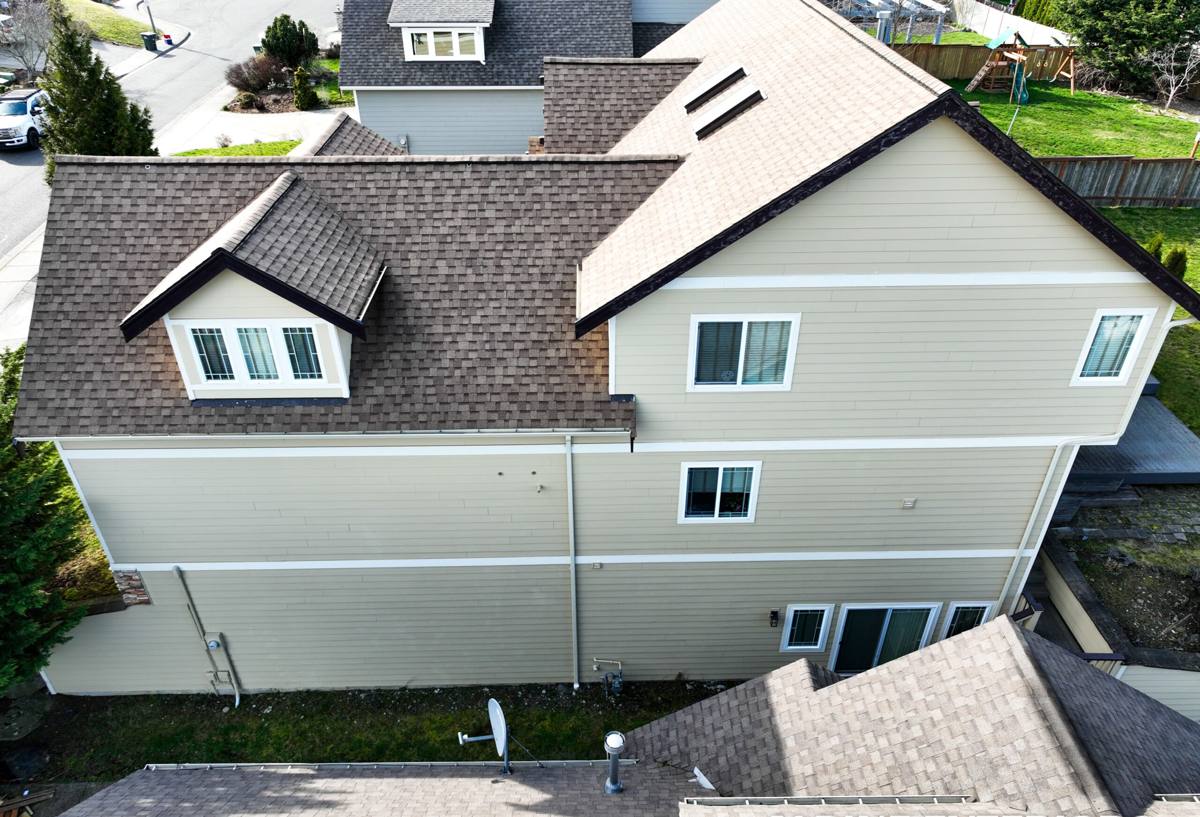
Why Asphalt Shingles Still Make Sense on the Coast
Asphalt shingles remain the most practical roofing material for most Marietta homes. They're proven in wet coastal climates, they're serviceable in sections rather than requiring a full tear-off for every repair, and the better product lines now carry algae-resistant granules that matter a great deal in a place with this much moss and moisture exposure. The key is not avoiding asphalt shingles — it's choosing the right shingle line and installing it correctly for a marine environment.
Architectural vs. 3-Tab Shingles
Architectural (laminated) shingles are the better choice for nearly every Marietta home. They're heavier, they sit flatter against wind-driven rain, and their multi-layer construction sheds water more reliably than a 3-tab shingle. 3-tab shingles are lighter, less wind-resistant, and generally not what we'd recommend for a property exposed to bay winds, even though they cost less up front.
Algae-Resistant Granules Are Not Optional Here
Whatcom County's damp, shaded conditions are close to ideal for algae and moss growth on a roof surface. Standard shingles without algae-resistant (AR) granules will streak and green up faster in this climate. We install AR-rated shingle lines as standard practice on Marietta roofs — it's a small cost difference for a meaningful reduction in staining and surface degradation over the life of the roof.
What a Correct Installation Actually Involves
A roof that looks right from the ground and a roof that's actually built right are two different things. The parts that determine how a shingle roof performs in a place like Marietta are mostly invisible once the job is finished, which is exactly why they get shortcut on lower-quality installs.
Tear-Off and Deck Inspection
We don't install over an existing layer of shingles. A full tear-off lets us actually see the roof deck — soft spots, rot around old flashing, or trapped moisture from a prior leak won't show up any other way. In a wet climate, roofing over a compromised deck just seals the problem in.
Underlayment and Ice-and-Water Barrier
Synthetic underlayment goes down over the full deck as a secondary water barrier, and we run self-adhering ice-and-water shield at eaves, valleys, and any roof-to-wall transition — the spots where wind-driven rain off the bay is most likely to find a way in. This detail matters more in Marietta than it does further inland, where storms hit with less direct exposure.
Flashing Details That Get Skipped
Step flashing at walls, counter-flashing at chimneys, and properly lapped valley metal are the difference between a roof that sheds water and one that eventually leaks at every transition. These are labor-intensive, low-visibility details, which is exactly why rushed jobs cut corners here first. We don't reuse old flashing on a reroof — it's inexpensive relative to the rest of the job and it's the piece most likely to fail first if it's compromised.
Ventilation
A shingle roof with poor attic ventilation traps moisture underneath the deck, which shortens the life of the shingles from below regardless of how well the top side was installed. We check ridge and soffit venting on every reroof and correct it when it's inadequate, rather than installing new shingles over an attic setup that's already working against the roof.
Moss, Algae, and Salt Air: The Maintenance Reality
Even a well-built roof in Marietta needs periodic attention that a roof in a drier climate doesn't. Moss doesn't just sit on the surface — left long enough, it lifts shingle edges and holds moisture against the roof deck, which accelerates rot underneath. Salt air accelerates corrosion on exposed metal fasteners and flashing over time, which is part of why we use corrosion-resistant fasteners and flashing materials rated for coastal exposure rather than standard-grade hardware.
None of this means constant maintenance — it means a roof built with the right materials from the start, plus occasional moss removal and gutter clearing, rather than a wait-and-see approach that lets moss establish itself over a few damp seasons.
What Drives Cost and Lifespan on a Marietta Roof
Homeowners often ask why one roofing quote is significantly different from another for what sounds like the same job. The honest answer is usually in the details below — material grade, underlayment choice, and how much flashing and deck repair the job actually needs once the old roof comes off.
| Factor | Budget Approach | What We Recommend for Marietta |
|---|---|---|
| Shingle line | Standard 3-tab, no AR granules | Architectural shingle with algae-resistant granules |
| Underlayment | Minimal felt coverage | Full synthetic underlayment plus ice-and-water shield at vulnerable areas |
| Flashing | Reuse existing flashing | New corrosion-resistant flashing at all transitions |
| Fasteners | Standard galvanized | Coastal-rated corrosion-resistant fasteners |
| Ventilation | Left as-is | Inspected and corrected as part of the reroof |
The budget approach isn't necessarily wrong for every situation, but on a property this close to the bay, the cheaper choices tend to show their cost in the form of an earlier repair or a shorter roof life rather than a lower total cost over time.
How We Approach a Roofing Job in Marietta
Our process is the same one we've used across Birch Bay, adjusted for what a given roof actually needs.
- On-site inspection of the existing roof, deck condition where visible, and attic ventilation.
- A written estimate that lays out the shingle line, underlayment, and flashing scope — not just a total price.
- Tear-off and deck inspection, with any rot or soft spots addressed before new material goes down.
- Underlayment, ice-and-water shield, new flashing, and shingle installation in that order.
- Final walk-through and site cleanup, including magnetic sweep for stray fasteners.
We give homeowners a straight answer if a roof can be repaired rather than replaced — a full reroof isn't always the right call, and we'd rather tell a homeowner that a section repair will hold for several more years than sell a job that isn't needed yet.
Why a Crew That Already Works Marietta Matters
A roofing crew that mainly works drier, more sheltered inland areas doesn't necessarily build the same way a crew that works Birch Bay and Marietta regularly does. We size ice-and-water coverage, fastener grade, and flashing details for what this specific stretch of coastline does to a roof over time, because we see the results of both good and rushed installs on properties in this area. That's not a marketing point — it changes which underlayment we spec and how much flashing goes into a given job.
Being local also means faster response for a storm-related repair or an inspection before a sale, and a crew that will still be reachable years after the job is done if a question comes up.
Signs Your Marietta Roof Needs a Look
- Moss buildup along shingle edges or in valleys, especially on north- or shade-facing slopes
- Granules collecting in gutters or at downspout outlets
- Curling, cupping, or cracked shingles, particularly on sections exposed to direct bay wind
- Rust staining or visible corrosion at flashing, vents, or fasteners
- Water stains on interior ceilings, especially near chimneys, skylights, or wall intersections
- Daylight visible through the roof deck from inside the attic
- A roof over 15-20 years old that hasn't had a professional inspection recently
Catching these early is almost always cheaper than waiting until a leak shows up inside the house — by the time water is visible on a ceiling, it's usually been getting into the structure for a while.
Asphalt Shingles vs. Other Roofing Options for This Climate
We're occasionally asked why we don't push metal roofing or other alternatives for a coastal property. Metal has real advantages in some situations, but it also comes with its own trade-offs here — higher upfront cost, noise considerations, and installation sensitivity around coastal corrosion that requires the right fastener and coating specification to avoid problems down the line. For most Marietta homes, a properly specified architectural asphalt shingle roof offers the best balance of upfront cost, proven coastal performance, and straightforward future repairs. We'll walk through the honest trade-offs of each option for your specific roof rather than steering every job toward one product.
If your roof in Marietta is due for a repair, a reroof, or just an honest inspection, we're glad to take a look. Reach out for a free, no-pressure estimate using the form below.