 Birch Bay Siding
 Windows Built for the California Creek Stretch of Birch Bay
California Creek sits close enough to the water that homes here take a different kind of weathering than houses even a few miles inland. Salt-laden air moves off the water and settles on everything — glass, hardware, trim, siding. Driving rain comes in sideways during winter storms, testing every seal and joint a window has. And Whatcom County's long, damp shoulder seasons mean moss and mildew get months of extra runway on anything that stays wet. Windows in this pocket of Birch Bay don't fail because homeowners neglected them. They fail because they were never built or installed with this specific combination of conditions in mind.
When we talk about "energy-efficient windows" for a California Creek home, we're not just talking about a sticker rating. We're talking about a window and an installation that can shed wind-driven rain, resist salt corrosion on hardware and hinges, and hold an airtight seal through freeze-thaw cycles and constant humidity — while also cutting the heating bill. Get any one of those wrong and the others don't matter much.
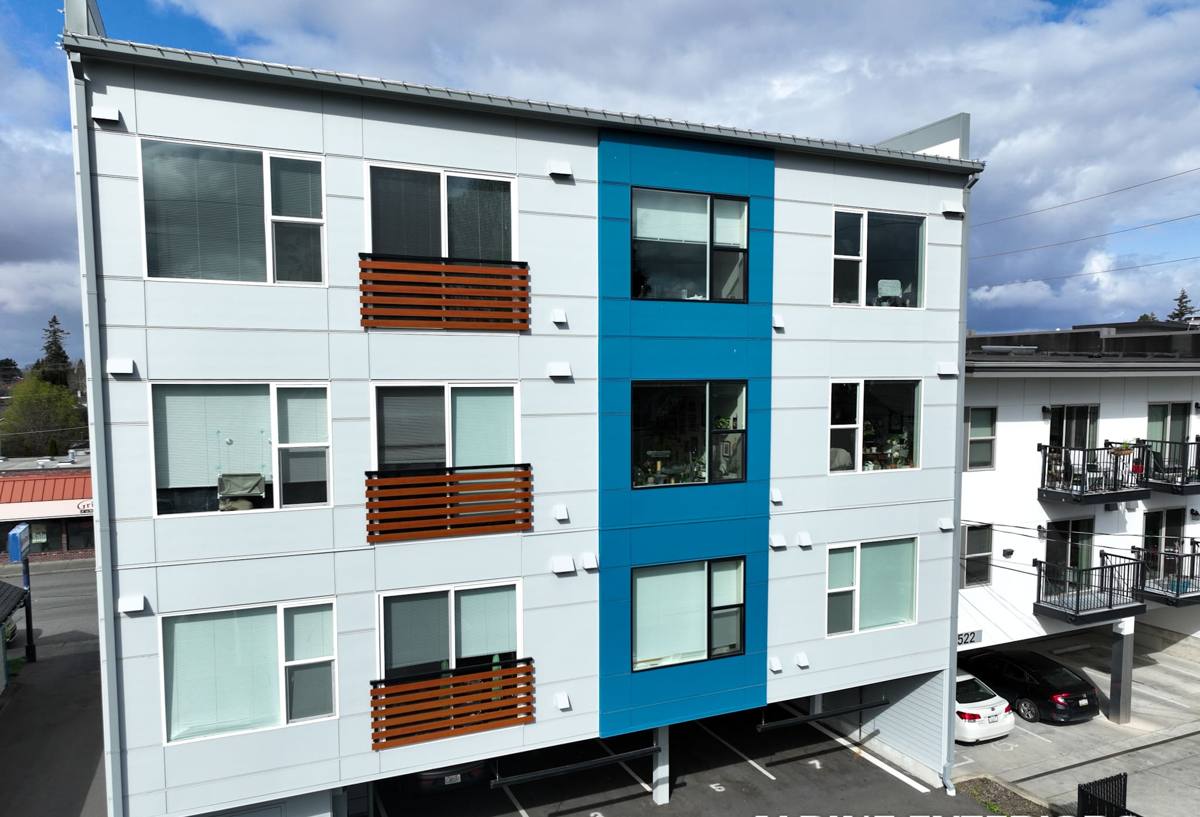
What Salt Air and Driving Rain Actually Do to a Window
It helps to know what's actually working against a window here, because it explains why some products and installation shortcuts that hold up fine in a dry inland climate don't hold up in Birch Bay.
Corrosion of hardware and fasteners
Salt air accelerates corrosion on exposed metal — hinges, cranks, locks, and the fasteners holding the frame in place. Once corrosion starts, hardware binds, locks stop seating properly, and a window that used to seal tight starts leaking air around the sash.
Wind-driven water intrusion
Ordinary rain falling straight down is easy for almost any window to handle. Rain being pushed sideways by wind off the water is a different problem — it tests the flashing, the sill pan, and the sealant joints, not just the window unit itself. Most water intrusion we find in this area traces back to installation details around the window, not the window itself.
Moss, mildew, and trapped moisture
A long moss season means anything that stays damp — a sill that doesn't drain, a corner where caulking has failed — stays damp for weeks at a time instead of drying out between rains. That sustained moisture is what rots wood trim and delaminates poorly-sealed frame materials.
Condensation and heat loss
Older single-pane or early double-pane windows in this climate tend to run condensation on the inside during cold, humid stretches. That moisture on the glass and sill contributes to the same rot and mildew problems, on top of the energy loss from a poor-performing unit.
What "Energy-Efficient" Should Mean for This Climate
Energy efficiency ratings are useful, but they were designed as a national standard — they don't account for salt exposure or wind-driven rain. For a California Creek home, we look at efficiency and durability together.
- U-factor: measures heat loss through the window. Lower is better for our cool, wet winters — this is the number that most directly affects your heating bill.
- Solar Heat Gain Coefficient (SHGC): matters less here than in sunnier climates, but still affects comfort on the west- and south-facing rooms that do get direct sun.
- Glazing and gas fill: double-pane with argon fill is the practical baseline for this region; triple-pane adds cost and weight but can be worth it on exposed elevations or noise-sensitive rooms.
- Frame material: in a salt-air, high-moisture environment, frame material affects long-term durability as much as it affects energy performance.
Frame material trade-offs near the water
| Frame Material | Moisture & Salt Resistance | Maintenance | Typical Lifespan |
|---|---|---|---|
| Vinyl | Good — won't corrode or rot, but welded corners can be a weak point in driving rain if not detailed well | Low | 20–30 years |
| Fiberglass | Very good — dimensionally stable, holds paint and seals well over time | Low | 30–40 years |
| Wood / wood-clad | Requires careful detailing and upkeep — attractive but the most vulnerable to sustained moisture | Higher | Varies widely with maintenance |
| Aluminum | Prone to corrosion in salt air and conducts heat poorly without a thermal break | Moderate | 20–25 years |
We don't tell homeowners there's one "right" material for every house — a wood-clad window can be the right call on a sheltered elevation, while a fully exposed, water-facing wall does better with vinyl or fiberglass. What we won't do is install a product on an exposed wall in this neighborhood without being upfront about the maintenance commitment it carries.
Why the Installation Matters More Than the Window Itself
We've said it above and it's worth repeating as its own point: most of the window failures we see in coastal Whatcom County homes are installation failures, not product failures. A premium window installed with a shortcut sill pan or minimal flashing will leak. A mid-range window installed correctly, with the right flashing sequence and sealant, will often outperform it.
What a correct installation actually includes
- A sloped or pan-flashed sill that directs any intruded water back outside instead of into the wall cavity
- Proper integration with the house wrap or weather-resistive barrier — flashing tape shingled correctly so water sheds down and over each layer
- Backer rod and sealant at the exterior joint sized and installed to move with the building without failing in a season or two
- Shimming and fastening that keeps the frame square, so the sash seals evenly and hardware doesn't bind prematurely
- Insulation in the gap between frame and rough opening — not stuffed too tight, not left with gaps
Any one of these done poorly can undo the performance of an otherwise good window within a few wet winters.
Our Process for a California Creek Window Project
The steps are the same as anywhere, but the details we check are shaped by this specific site.
- On-site assessment: we look at each opening's exposure — which walls take direct wind-driven rain, which are sheltered, and where existing moisture damage or hardware corrosion is already showing.
- Product recommendation: we walk through frame material and glazing options honestly, including trade-offs, rather than pushing one product line regardless of fit.
- Prep and removal: old units come out carefully so we can inspect the rough opening, sill, and surrounding sheathing for hidden rot or moisture damage before anything new goes in.
- Flashing and sealing: this is where we spend the extra time — sill pans, flashing tape, and sealant done to hold up against driving rain, not just pass a quick visual check.
- Install and adjust: units are set square and level, shimmed, insulated, and tested for smooth operation before we finish trim work.
- Walkthrough and cleanup: we go over operation and care with you, including simple maintenance that extends the life of the install in this climate.
Signs Your Current Windows Are Already Costing You
Homeowners in this area often live with a slowly worsening window problem for years before calling anyone, because none of the individual symptoms seem urgent on their own.
- Noticeable draft near the frame, especially during windy, wet weather
- Condensation or fogging between the panes (a sign the seal has failed on a double- or triple-pane unit)
- Sashes that are hard to open, close, or lock — often a sign of hardware corrosion or a frame that's racked slightly out of square
- Visible gaps, cracked caulking, or soft/discolored trim around the window exterior
- A heating bill that's crept up without an obvious cause
- Moss, algae, or dark staining building up on the sill or the wall just below it
Any one of these on its own might not mean much. Two or three together, especially on the same wall, usually mean water is getting somewhere it shouldn't.
Why Local Experience in Birch Bay Matters
A crew that mostly works drier, inland jobs will still build a technically sound window install — the framing and flashing steps don't change on paper. What changes is judgment: knowing which elevations in a place like California Creek take the brunt of the weather, recognizing early corrosion or rot before it's obvious, and not being surprised by how much a shoulder-season moss problem can hide until you look closely. Working this stretch of Whatcom County regularly means we've seen how different frame materials and installation details actually hold up here over years, not just in a manufacturer's spec sheet.
It also means straightforward answers. If a product isn't a good fit for a fully exposed wall facing the water, we'll say so and explain why, rather than let a homeowner find out after a couple of wet winters.
What Affects the Cost
Every home and opening is different, so exact numbers depend on a site visit, but the main cost drivers on a California Creek window project are consistent.
| Cost Factor | Why It Matters |
|---|---|
| Frame material | Vinyl and fiberglass generally run less than premium wood-clad units; fiberglass typically costs more than vinyl but lasts longer |
| Glazing (double vs. triple-pane) | Triple-pane adds upfront cost and weight in exchange for better insulation and sound dampening |
| Number and size of openings | Larger or custom-sized windows cost more per unit than standard sizes |
| Condition of the rough opening | Hidden rot or moisture damage found during removal adds repair work before the new window can go in |
| Access and elevation | Upper-story or hard-to-reach windows take more labor time |
As a broad range, homeowners in this area typically plan on a few hundred to a couple thousand dollars per window installed, with the wide spread driven mostly by size, material, and how much repair work the opening needs. We'll always give you specifics for your home before any work starts.
If your California Creek home has drafty windows, fogged glass, or trim that's starting to show its age, we're happy to take a look and give you a straightforward, no-pressure estimate — just fill out the form below.