 Birch Bay Siding
 Why Point Roberts Decks Wear Out Faster Than You'd Expect
Point Roberts sits out on its own stretch of shoreline, with water on three sides and very little standing between a deck and whatever the weather is doing that day. Homes there deal with a heavier dose of salt air than most of Whatcom County, plus driving rain that comes in sideways during winter storms and a moss season that can start early and hang on late. None of that is unique to any one house — it's just the baseline for anything built outdoors in this part of the county, and it's the reason deck repair here is a different job than deck repair in a sheltered inland yard.
Salt air is the quiet one. It doesn't announce itself the way a leak or a soft board does. Instead it works on metal — fasteners, brackets, post bases, ledger hardware — corroding it slowly until a connection that looked fine on the surface is no longer doing its job underneath. Driving rain adds a second problem: it finds every gap in flashing, every unsealed screw hole, every spot where a board butts up against the house, and it pushes water into places gravity alone wouldn't reach. Then moss and algae move in on any surface that stays damp and shaded, turning boards slick and holding moisture against the wood long after a sunny day would normally have dried things out.
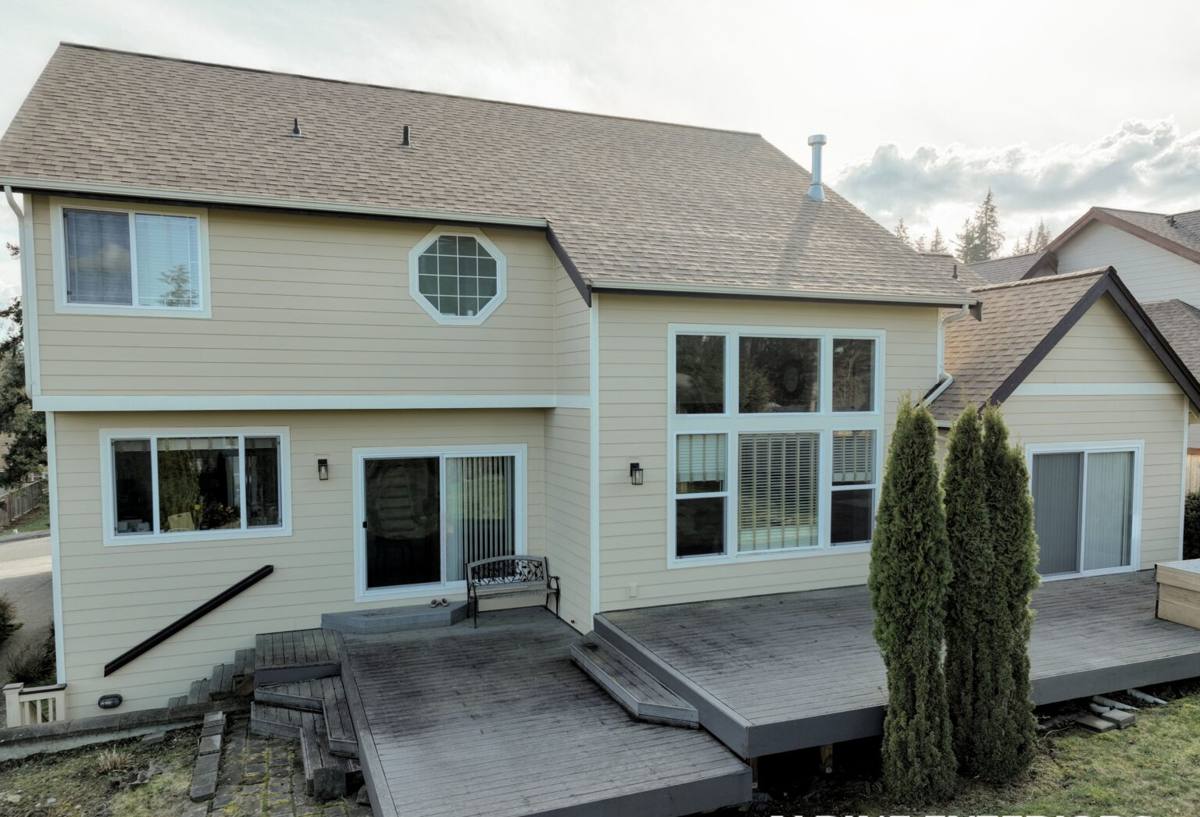
Signs a Point Roberts Deck Needs Repair Now, Not Later
Deck problems in this climate rarely start as an emergency. They start small and get quietly worse over a wet winter, then show up as something more serious the following spring. A few things worth checking before they turn into bigger repairs:
- Soft or spongy spots underfoot, especially near the house or along board edges
- Rust streaks bleeding out from screws, bolts, or metal connectors
- Gaps or separation where the deck meets the house at the ledger board
- Green or black staining that keeps coming back within weeks of cleaning
- Boards that have visibly cupped, split, or pulled away from their fasteners
- A railing or post that flexes more than it used to
- Standing water that doesn't drain within an hour or two after rain
Any one of these on its own might be minor. Several at once, or any sign of movement in the framing, usually means it's worth having someone look at the structure underneath, not just the boards on top.
What a Correct Deck Repair Actually Involves
Structural Inspection Comes First
The single biggest mistake in deck repair is treating it as a cosmetic job — replacing a bad board or two and calling it done without checking what's underneath. A proper repair starts with the framing: the ledger board where the deck attaches to the house, the joists, the beams, the posts, and the footings. In a climate that pushes this much moisture into a structure over the course of a year, rot often starts at connection points long before it's visible from the top. We check for soft wood with a probe, look for water staining or gaps at the ledger, and confirm posts and footings are still doing their job before we touch a single deck board.
Fasteners and Hardware Matter More Here
Salt air shortens the working life of ordinary fasteners. A repair that goes back together with whatever hardware was on hand is a repair that starts corroding again almost immediately. We use hot-dip galvanized or stainless fasteners and connectors sized for coastal exposure, and we replace corroded hardware we find during the repair rather than leaving it in place just because the wood around it still looks sound.
Flashing and Water Management
Most serious deck failures trace back to water getting into the ledger connection or pooling somewhere it shouldn't. Correct flashing at the house connection, proper slope for drainage, and gaps between boards that let water pass through instead of collecting are all part of a repair that's meant to last — not just patch the symptom.
Dealing With Moss and Surface Wear
Moss and algae aren't just a slip hazard — sustained dampness under a layer of moss accelerates wood decay. Repair work in this climate usually includes a proper clean of the surface, treatment to knock back regrowth, and in some cases adjusting how a deck dries out — trimming back overhanging growth, improving airflow underneath — so the problem doesn't just come back with the next wet season.
Repair or Replace? What Actually Drives That Decision
Homeowners often ask whether it's worth repairing an older deck or better to plan for a full rebuild. There's no single answer — it depends on what we find once we're into the structure.
| Factor | What It Tells Us | Typical Direction |
|---|---|---|
| Condition of the ledger board | Rot here affects the whole deck's attachment to the house | Often points toward replacement if compromised |
| Extent of rot in joists and beams | Isolated vs. widespread decay | Isolated: repair. Widespread: replace |
| Age of the structure | Older framing may be near the end of its service life regardless of surface condition | Leans toward planning a rebuild |
| Post and footing stability | Movement or settling changes the whole scope | Usually requires structural work either way |
| Budget and timeline | Repair is cheaper short-term; replacement resets the maintenance clock | Homeowner's call, informed by the above |
Costs for deck repair in this area range widely depending on scope — from a few hundred dollars for isolated board or hardware replacement up to several thousand for structural rework involving the ledger, joists, or posts. A full rebuild is its own conversation. We'll give you a straight answer on which category your deck falls into before any work starts, not after.
Our Deck Repair Process
Assessment
We start by getting under the deck as well as walking the surface — checking framing, connections, and moisture levels rather than just eyeballing the boards on top. This is where most of the real information comes from.
Scope and Estimate
You get a clear picture of what's structural, what's cosmetic, and what's optional. We separate "needs to happen" from "worth doing while we're in there" so you can make an informed call on scope and budget.
The Repair Itself
Structural issues get addressed first — framing, connections, flashing — before any surface work. Board replacement, fastener upgrades, and moss treatment come after the structure underneath is sound.
Cleanup and Care Guidance
We leave the site clean and walk you through what to watch for going forward — the early signs of the same wear patterns, and a realistic sense of how often a deck in this climate needs a maintenance check.
Material Choices for a Salt-Air, High-Rain Climate
When repair work calls for replacing sections of decking, the material choice matters more here than in a drier, more sheltered location. Pressure-treated lumber holds up well when properly sealed and maintained, but it needs that upkeep to keep performing in this much moisture. Cedar looks good and resists rot naturally to a point, but it's softer and more sensitive to the freeze-thaw and constant damp of a marine climate. Composite decking costs more upfront and doesn't need staining or sealing, but it has its own installation requirements — proper spacing and ventilation matter more with composite than with wood, since trapped moisture underneath causes different problems.
Our standard is to match the material to how exposed a given deck is and how much upkeep the homeowner actually wants to commit to, rather than defaulting to whatever's cheapest or whatever we happen to have on the truck. We'll walk through the trade-offs honestly as part of the estimate.
Why a Crew That Already Works Point Roberts Matters
Point Roberts is its own kind of logistics challenge for a contractor. It's not a place you swing by on the way to somewhere else — getting crew and materials out there takes planning, and a company that doesn't already build that into its schedule tends to either avoid the area or treat it as a low-priority add-on. We already work Point Roberts regularly, which means material deliveries, crew time, and follow-up visits are planned around the reality of getting there, not squeezed in as an afterthought.
It also means we've seen how houses out there actually age — which connections fail first, which sides of a deck take the worst of the wind-driven rain, where moss tends to establish itself fastest. That's the kind of knowledge that comes from repeated work in one specific place, not from a general checklist.
Keeping a Repaired Deck in Good Shape
A repair is only as good as the maintenance that follows it. In this climate, that generally means an annual look at fasteners and connections for early rust, keeping the surface clear of built-up debris and moss before it takes hold, and confirming drainage paths stay clear going into the wet months. None of it needs to be complicated, but skipping it is usually how a small, cheap fix turns into a bigger one a few years down the line.
If you're noticing soft spots, rust, recurring moss, or just want an honest read on where your deck stands, we're happy to take a look. Estimates are free, there's no pressure attached, and you'll get a straight answer on what actually needs doing — the form below is the easiest way to get started.