 Birch Bay Siding
 Point Roberts Puts Real Stress on Exterior Siding
Point Roberts sits on a peninsula bordered by water on three sides, which means homes here take a different kind of weather beating than houses just a few miles inland. Salt-laden air moves off the water and settles on exterior surfaces day after day. Wind-driven rain doesn't just fall straight down here — it gets pushed sideways into wall assemblies, seams, and trim joints. And because the area stays cool and damp for long stretches of the year, moss and algae get a head start on any siding surface that holds moisture or sits in shade.
None of this is unusual for a Whatcom County waterfront community, but it does mean siding decisions that work fine in a drier inland climate don't always hold up the same way in Point Roberts. Materials that are marginal in moisture resistance, or that depend on a homeowner keeping up with regular sealing and painting, tend to show their weaknesses here faster than they would elsewhere.
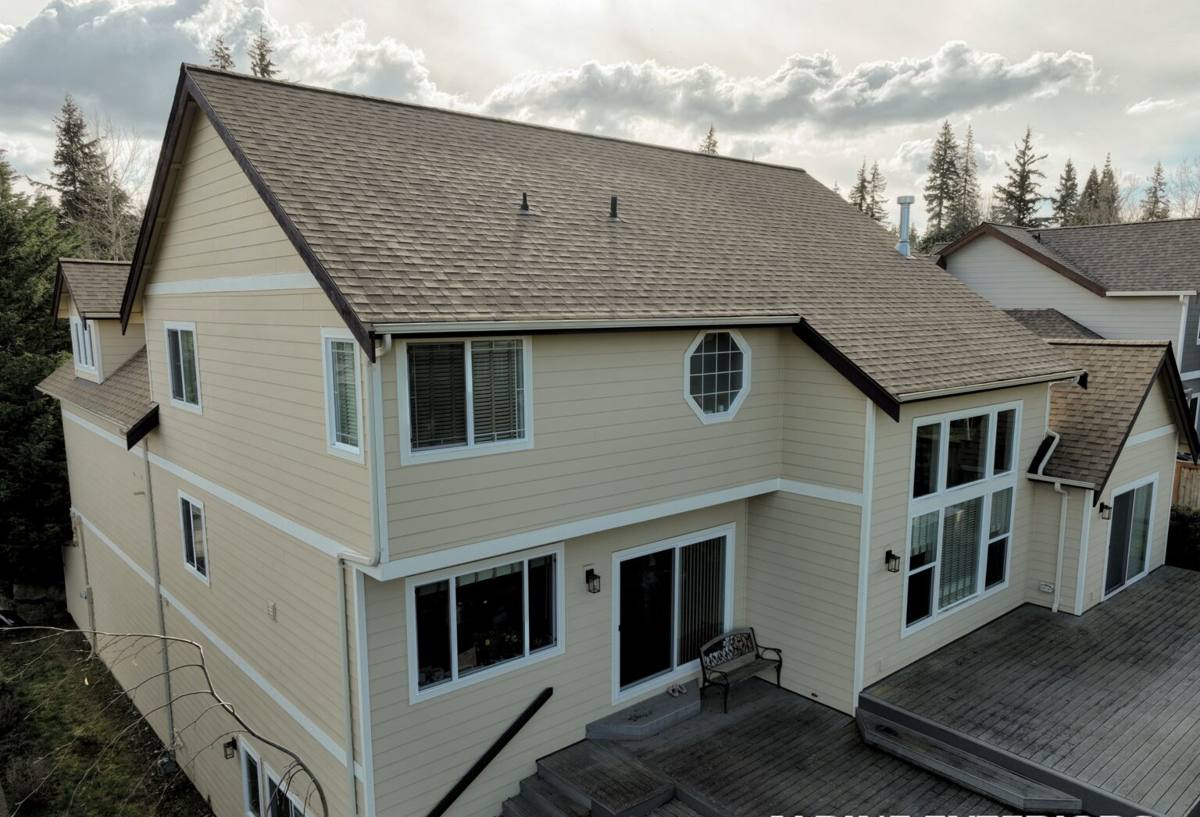
Warning Signs a Point Roberts Home Needs Siding Replacement
Siding failure is rarely sudden. It shows up as a series of small signals that, taken together, mean the wall assembly is no longer doing its job. In a salt-air, high-moisture environment like this one, watch for:
- Soft or spongy spots when you press on the siding, especially near the bottom of walls or under windows
- Paint that's peeling, bubbling, or needing repainting far more often than it used to
- Persistent moss, algae, or dark streaking that comes back within a season of cleaning
- Visible warping, cupping, or gaps opening up at panel seams and corner boards
- Rising energy bills or drafts that suggest the wall assembly is no longer sealing properly
- Rot or staining around windows, doors, or anywhere trim meets siding
Any one of these can be a minor repair. Several of them together, especially on a home that's due for new siding anyway, usually mean it's time to look at full replacement rather than another round of patching.
What a Correct Siding Replacement Job Actually Involves
Tear-Off and Inspection
A proper job starts with removing the old siding down to the sheathing, not installing over top of it. That's the only way to actually see what's happening underneath — soft sheathing, old water damage, or a weather barrier that's failed doesn't show up until the old siding comes off. In a wet climate like Point Roberts, this step matters more, not less, because hidden moisture problems are more common here than in drier regions.
Moisture Management Behind the Siding
Siding is really the last layer of a system, not the whole system. Behind it needs to be a continuous, properly lapped weather-resistive barrier, correctly integrated flashing at every window, door, and roof-to-wall transition, and enough of a gap for any moisture that does get behind the cladding to drain and dry out rather than sit against the wall. Skipping or rushing this layer is the single most common reason siding fails early in wet coastal climates — the visible material can look fine while the wall behind it is quietly rotting.
Fastening and Clearances
Fiber cement siding has a specific fastening schedule and clearance requirements — distance from grade, from roof lines, from decks and patios — that are there specifically to keep the bottom edge of the siding from sitting in standing water or constant splash-back. In a peninsula environment with a lot of driving rain, getting these clearances right is not optional detail work; it's what keeps the bottom courses of siding from failing years before the rest of the wall.
Comparing Materials for a Salt-Air, High-Moisture Climate
Homeowners planning a replacement often ask what the real differences are between the common siding options. Here's an honest comparison focused on what actually matters in a marine environment like Point Roberts:
| Material | Moisture behavior | Maintenance | Typical lifespan |
|---|---|---|---|
| Vinyl | Doesn't rot, but can warp or crack in temperature swings and doesn't stop wind-driven rain from reaching the wall behind it as effectively as a rigid product | Low, but color fades and it's difficult to repair invisibly | 20–30 years, often less with UV and impact damage |
| LP SmartSide (engineered wood) | Wood-based core is more moisture-sensitive; edges and cut ends need diligent sealing to resist swelling | Moderate — repainting and edge sealing on a regular cycle | 20–30 years with consistent upkeep |
| Cedar | Natural material that absorbs and releases moisture; prone to moss growth and rot without diligent upkeep | High — regular sealing, staining, and moss treatment | Variable, heavily dependent on maintenance |
| James Hardie fiber cement | Non-combustible, dimensionally stable, engineered moisture resistance built into the product | Low — factory finish holds color without repainting on the usual cycle | Long service life when installed to spec, backed by a strong transferable warranty |
Every one of these products has legitimate uses somewhere. Our position is specific to what holds up best on this stretch of coastline, under this amount of salt exposure and rainfall, over the long haul.
Why We Install Only James Hardie Fiber Cement
We standardized on James Hardie because fiber cement is fundamentally more stable in a wet, salt-exposed environment than wood-based or vinyl alternatives. It doesn't swell, rot, or feed moss growth the way organic materials can, and it's non-combustible, which matters for insurance and peace of mind regardless of climate. James Hardie's ColorPlus factory-applied finish is baked on under controlled conditions and holds color far longer than field-applied paint, which is a real advantage in a climate that's hard on painted surfaces.
Hardie also builds climate-specific HZ product lines engineered for different moisture and freeze conditions around the country, which is exactly the kind of product-level detail that matters more in a coastal microclimate than in a generic backyard installation. Backed by a strong transferable warranty and a genuinely long track record when installed correctly, it's the product we're comfortable standing behind on every home we side — including the ones a few hundred feet from saltwater.
What Drives the Cost of a Point Roberts Siding Replacement
Every home is different, but the same handful of factors drive most of the cost variation we see on replacement projects out here:
| Factor | Why it matters |
|---|---|
| Home size and wall complexity | More square footage, more corners, dormers, and trim details all add labor time |
| Condition of the existing wall assembly | Hidden rot or sheathing damage found during tear-off adds repair scope before new siding can go on |
| Existing siding type | Some materials remove faster and cleaner than others |
| Trim and detail work | Corner boards, window and door trim, and fascia detailing add finish-carpentry time |
| Product line and color selection | Different Hardie profiles and factory finishes carry different material costs |
| Site access and logistics | Delivery and staging on a peninsula community take more planning than a typical mainland job |
We walk through every one of these during the estimate so there are no surprises once work starts, and we flag anything that looks likely to add scope before we begin, not after.
Our Process, Start to Finish
- On-site inspection of the current siding, trim, and any visible moisture or rot issues
- A detailed, written estimate that lays out material, labor, and any repair work the inspection turned up
- Product and color selection from James Hardie's available lines and finishes
- Scheduling, including logistics specific to working on the peninsula
- Full tear-off, sheathing inspection, and any needed repairs before new material goes on
- Installation of the weather-resistive barrier, flashing, and new Hardie siding to manufacturer spec
- Final walkthrough and site cleanup before we consider the job done
Why Hiring a Crew That Already Works Point Roberts Matters
Point Roberts is geographically separated from the rest of Whatcom County — reaching it by land means crossing an international border, which adds a layer of planning that a typical mainland siding job doesn't require. Material deliveries, crew scheduling, and equipment logistics all need to account for that, and a crew that hasn't done it before can end up costing you time on delays that a crew with local experience simply plans around.
Beyond logistics, there's real value in a crew that's used to building for this specific stretch of coastline. Knowing how much salt exposure a wall assembly actually needs to handle, how aggressive the moss season really gets, and where wind-driven rain tends to find weak points in a typical installation isn't something you get from a spec sheet — it comes from doing the work here repeatedly. That local familiarity shows up in the small decisions on every job: where extra flashing attention goes, how clearances get handled on a low grade near the water, and which details get extra care because we've seen what happens when they don't.
Questions Worth Asking Before You Commit
Whoever you hire, a few questions will tell you a lot about whether they're set up to do this job right in this climate:
- Will the old siding be fully removed, or installed over?
- What's the plan for the weather-resistive barrier and flashing details?
- What clearance will the bottom of the siding have from grade, decks, and roof lines?
- Is the warranty from the manufacturer, the installer, or both — and what does it actually cover?
- Have they worked on Point Roberts before, and do they understand the logistics involved?
A contractor who answers these clearly and specifically, rather than vaguely, is generally one who takes the details seriously.
If your Point Roberts home is showing signs of siding wear, or you're planning ahead for a replacement, we're happy to take a look and walk you through what we'd recommend — no pressure, no obligation. Use the form below to request a free estimate.