 Birch Bay Siding
 Why Blaine's Exterior Homes Face a Tougher Fight Than Most
Blaine sits right where Whatcom County meets Semiahmoo Bay and the Canadian border, and that location comes with a specific kind of exterior wear. Homes here take on salt-laden air blowing off the water, near-constant winter rain that drives sideways instead of falling straight down, and long stretches of overcast, damp weather that keep exterior surfaces wet far longer than homes even twenty miles inland. Add in the shade from mature evergreens common in Birch Bay and Blaine neighborhoods, and you get the third ingredient: moss and algae season that can run eight or nine months out of the year.
Siding that isn't engineered for this combination doesn't fail overnight. It fails slowly — a soft spot behind a downspout, a seam that's swelled just enough to let water in, a north wall that stays green no matter how often it's power-washed. By the time it's visible, moisture has usually been working on the wall assembly for a while. That's the standard we install against in Blaine: not "will this look fine on day one," but "will this hold up through fifteen winters of salt air and rain."
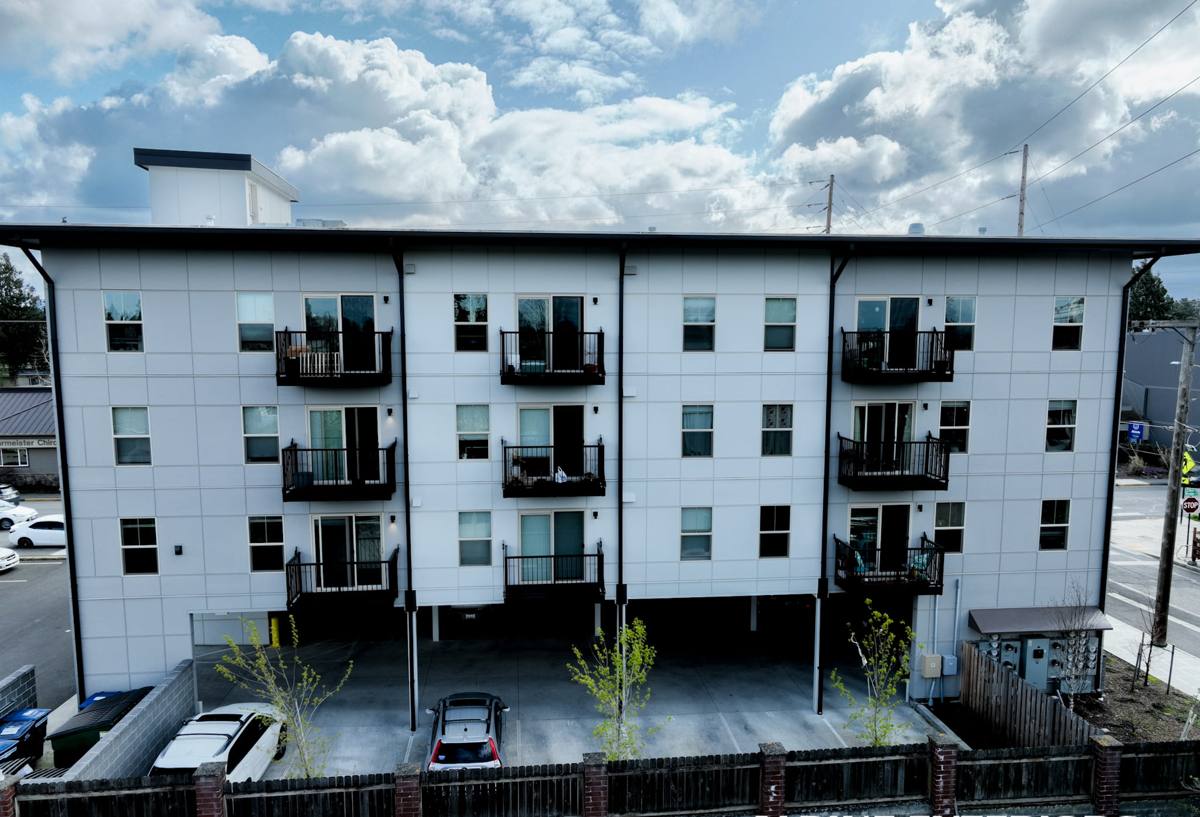
What Blaine Homes Actually Need From Their Siding
Talking with homeowners across Blaine and Birch Bay, the same handful of concerns come up again and again. A correct siding job for this area needs to answer all of them, not just one or two.
- Moisture resistance that doesn't rely on paint alone. The material itself has to shed and manage water, because coastal humidity means paint film gets stressed harder and more often than inland homes.
- Rot resistance at grade and around penetrations. Driving rain finds its way to the bottom courses, around hose bibs, and near deck ledgers faster here than in drier climates.
- Salt and wind tolerance. Materials that hold up fine in a dry climate can degrade faster near open water, where airborne salt accelerates wear on fasteners, caulking, and finishes.
- A finish that resists moss and mildew staining on shaded north- and west-facing walls, which are common on lots with tree cover.
- Impact and wind resistance during winter storm systems that regularly move through the Strait of Georgia area.
Vinyl, primed wood, and some engineered wood products can check one or two of these boxes. Very few products check all five, which is the core reason we standardized on one material rather than offering several.
Why We Only Install James Hardie Fiber Cement
We install James Hardie fiber cement siding exclusively — not vinyl, not LP SmartSide, not Cemplank or Allura, not primed spruce or cedar. That's a deliberate professional standard, not a sales preference, and it comes directly out of what we've seen hold up (and not hold up) on homes in this climate.
Fiber cement is a mix of Portland cement, sand, and cellulose fibers, cured into a dense, stable board. It doesn't rot, it isn't a food source for moss or algae the way wood-based products can be, and it's non-combustible. James Hardie backs its HZ5 product line specifically for climates like ours — cold, wet, and humid for most of the year — with a formulation and installation spec built around moisture management rather than moisture avoidance, which is the more realistic goal on the coast.
The factory-applied ColorPlus finish matters just as much as the board itself. It's baked on in a controlled environment rather than field-applied, which means better adhesion and a finish that's engineered to handle UV and moisture cycling — a real advantage over field-painted materials that depend on weather conditions at the time of application. For a home a few blocks from salt water, that factory finish is doing real work every day.
What This Means in Practice
Choosing one product line lets our crews specialize instead of switching techniques and materials from job to job. Every flashing detail, fastener pattern, and clearance measurement we use is tuned to Hardie's installation manual, not adapted on the fly from a different manufacturer's spec.
What a Correct Fiber Cement Installation Involves
Fiber cement siding is only as good as its installation. The board itself resists rot and moisture, but a job installed with the wrong clearances, fastener pattern, or flashing detail can still let water into the wall assembly behind it — and once that happens, the siding on top can look perfect while the sheathing underneath is compromised. Locally, we pay particular attention to:
| Detail | Why It Matters in Blaine's Climate |
|---|---|
| Ground clearance (minimum 6", ideally more near landscaping) | Driving rain and irrigation splash-back keep lower courses wet longer near the coast |
| Weather-resistive barrier and proper lap sequencing | A secondary drainage plane matters more here, where wind-driven rain regularly overwhelms the primary siding layer |
| Rain-screen gap where conditions call for it | Allows trapped moisture behind the siding to drain and dry instead of sitting against sheathing |
| Corrosion-resistant fasteners | Salt air accelerates corrosion on standard fasteners faster than it would inland |
| Caulking and sealant only where Hardie's spec calls for it | Over-caulking traps moisture; under-caulking lets it in — both are common mistakes on rushed jobs |
| Factory-cut edges kept sealed or primed | Field cuts expose raw material that needs proper sealing to match the factory finish's protection |
None of these details show up in a driveway estimate. They show up five, ten, and fifteen years later — either as a wall that's still doing its job, or as a callback nobody wants to make.
Our Process for a Blaine Fiber Cement Project
1. On-Site Assessment
We walk the exterior with you, looking specifically at moisture-prone areas: grade clearance, roofline transitions, deck and porch attachments, and any shaded walls already showing moss growth. This tells us whether we're doing a straightforward re-side or need to address underlying issues first.
2. Tear-Off and Sheathing Check
Old siding comes off and we inspect the sheathing underneath. In a marine climate, this step matters more than in drier regions — hidden moisture damage is more common here, and it's far cheaper to address before new siding goes up than after.
3. Weather Barrier and Flashing
We install or verify the weather-resistive barrier and flash every penetration, window, and door correctly before a single piece of Hardie board goes on. This is the layer that actually keeps a house dry if wind-driven rain gets past the siding face.
4. Installation to Manufacturer Spec
Fastener spacing, board overlap, and clearances follow James Hardie's published installation guide for our climate zone — not a generic approach used across every product line.
5. Final Walkthrough
We review the finished work with you, including care basics and what to watch for in year one, since a new siding system settles in over its first full winter cycle.
Why Hiring a Crew That Already Works Blaine and Birch Bay Matters
Fiber cement installation isn't complicated in theory, but the margin for error narrows considerably in a wet, coastal climate. A crew that mostly works drier inland areas may not automatically account for extra grade clearance, rain-screen detailing, or corrosion-grade fasteners — because in a drier climate, those details are less likely to cause visible problems for years. On the coast, the same shortcuts show up faster.
Working regularly in Whatcom County's coastal communities also means we're familiar with the practical side of the job: typical soil and drainage conditions around older homes in the area, how local weather windows affect scheduling a tear-off, and what moss and algae patterns to expect on which sides of a house before we even start. That local pattern recognition is hard to substitute for.
Signs Your Current Siding Is Losing the Fight
- Soft or spongy spots when pressed, especially near the bottom courses or below windows
- Paint that's peeling or bubbling rather than just fading
- Persistent green or black staining that returns within a season of cleaning
- Visible gaps, warping, or buckling at seams
- Rising energy bills that may point to compromised insulation behind failing siding
- Water stains on interior walls near exterior corners
Any one of these on its own isn't necessarily an emergency, but a combination is usually a sign the wall assembly has been dealing with moisture longer than it should have.
What Fiber Cement Siding Costs to Consider
Fiber cement carries a higher material and labor cost upfront than vinyl, largely because of the board's weight, the cutting tools it requires, and the precision the installation demands. That said, the total cost comparison should account for more than the invoice on installation day. Ranges vary based on home size, existing condition, and detail work (trim, corners, board-and-batten accents), so we'll always give you a specific number after seeing the actual house rather than a number that doesn't reflect your project.
| Factor | Impact on Project Cost |
|---|---|
| Home size and wall complexity | More corners, dormers, and transitions mean more cutting and detail labor |
| Existing sheathing condition | Rot repair discovered during tear-off adds cost but prevents covering up a bigger problem |
| Trim and accent choices | Board-and-batten sections, trim boards, and color combinations affect material and labor time |
| Access and site conditions | Tight lots, slopes, or landscaping close to the foundation can add setup time |
| Tear-off vs. overlay | A full tear-off costs more up front but is the only way to properly inspect and correct the wall assembly beneath |
Ready for a Straight Answer on Your Blaine Home
If your siding is showing its age, or you're planning ahead before the next wet season sets in, we're happy to take a look and give you an honest assessment — no pressure, no inflated urgency. Reach out for a free estimate, and we'll walk your home's exterior with the same eye we'd use on our own.